


Pinoy classics · Larong Pinoy · modern favorites
28 Filipino Kids Party Games: How to Play, Rules and Easy Variations
Planning a kid’s party in the Philippines does not mean filling the program with nonstop activities. Four or five well-chosen games can be enough when they fit the children, the space, the venue rules and the adults available to help.
This guide gives you 28 playable options—from familiar Filipino birthday-party games and Larong Pinoy to newer challenges and global favorites. Each main game now includes the player count, prep time, round length, equipment, a host cue, an example round, step-by-step mechanics and easier or no-elimination variations where useful.
If you are planning the whole celebration—not only the games—use our complete kids party planning guide for guest count, venue, food, timing and setup.
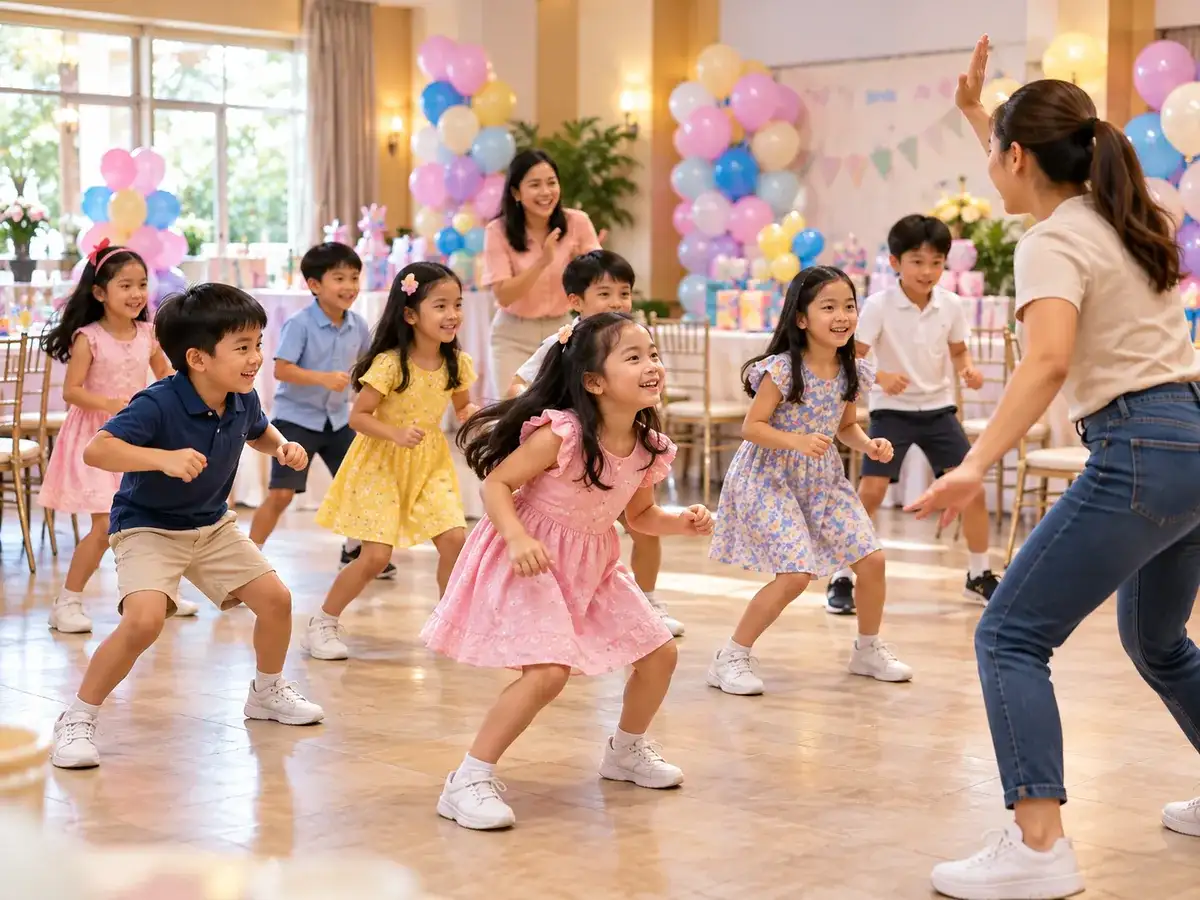
Start here: choose games that fit your party
Quick game finder
Find games that fit your party
Filter the 28 games, then jump straight to the instructions.
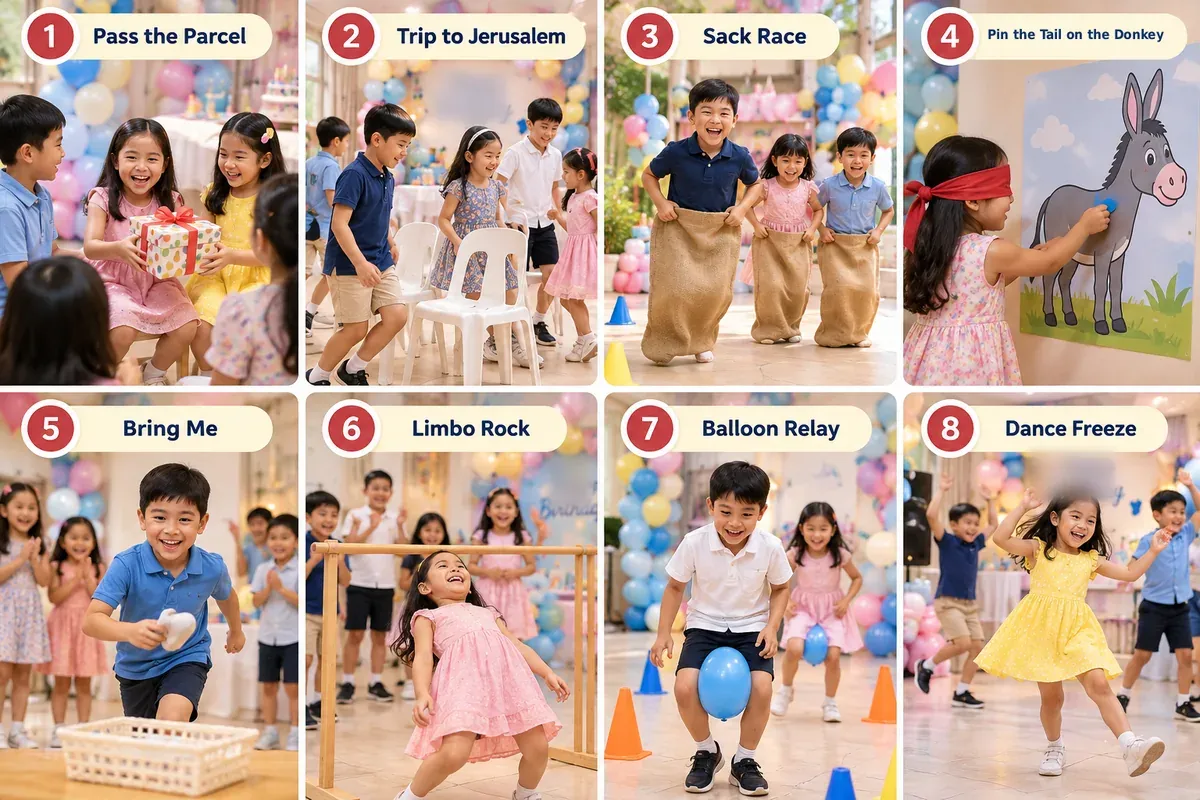
Treat these suggestions as a starting point, not an age guarantee. Children of the same age can have very different confidence, mobility, attention and familiarity with rules. If you have a mixed group, choose games that are easy to explain and easy to adjust.
Filipino party games and Larong Pinoy are not exactly the same thing
At Filipino birthday parties, people often use parlor games to mean the short, hosted games played during the program: Trip to Jerusalem, Bring Me, Stop Dance, The Boat Is Sinking and similar favorites. Some are international games that became familiar at Filipino celebrations.
Larong Pinoy or Laro ng Lahi refers more specifically to traditional Filipino games such as Patintero, Tumbang Preso and Piko. They are part of Filipino play culture and can be a great addition when the venue gives children enough safe space.
You can mix both. A party might open with Stop Dance, feature Pabitin, then use one Larong Pinoy game outdoors. The important thing is not whether every game comes from the same category. It is whether the lineup works for your guests and venue.
Classic Filipino Party Favorites
1. Trip to Jerusalem / Musical Chairs
Trip to Jerusalem is one of the most familiar children’s party games in the Philippines. Children move around a line or circle of chairs while music plays. When the music stops, everyone looks for a seat.
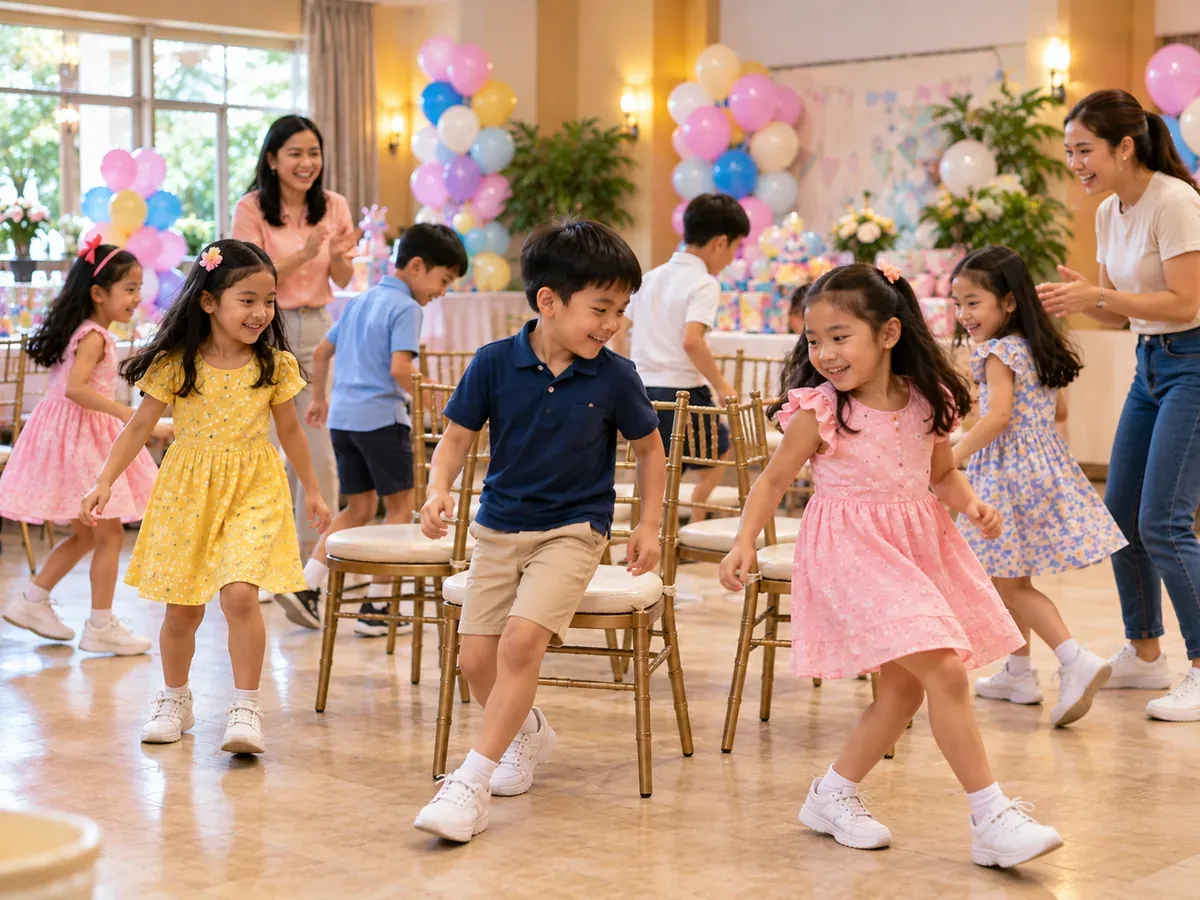
Best for: children who can follow a simple stop-and-go rule; medium indoor or covered spaces; groups that enjoy a little competition.
You need: sturdy chairs and music. Start with one fewer chair than the number of players for the traditional elimination version.
Space needed: enough room to walk around the chairs without pushing into walls, tables, décor, food stations or other guests.
Setup
Arrange the chairs so children can move around them easily. Make sure the chairs are stable, similar in size and appropriate for the players. Keep the play area away from the buffet, cake table, drinks, glassware and busy walkways.
How to play
- Ask the children to stand around the chairs.
- Start the music and have everyone walk around the outside of the chairs.
- Stop the music at an unpredictable time.
- When the music stops, each child finds a chair and sits down.
- In the traditional version, the child without a chair leaves that round and one more chair is removed.
- Start the music again and repeat until one player remains.
Basic rules
Walking is safer than running around the chairs, especially indoors. Players should not pull chairs away from one another, push another child, block a seat with their body or sit on another player. No one should stand on a chair at any point.
Easier or no-elimination version
For younger children or a group that does not enjoy elimination, keep enough chairs for everyone. When the music stops, ask everyone to sit, freeze in a funny pose beside a chair, or complete a simple prompt. You can award points or simply keep playing without removing anyone.
Adult tips
One adult should control the music while another watches the play area if the group is large. Show one practice round before starting if some children have never played before.
Watch out for
Do not use lightweight chairs that slide easily. Do not let the final round turn into grabbing or wrestling for a seat. If the group becomes too excited, slow the walking pace or switch to the no-elimination version.
Mechanics visual: chairs in the center → children moving around while music plays → music stops → children sit.
Set a stable chair loop, move while the music plays, then sit only after the stop signal.
- 1Set the chairs
Use one fewer chair than players for elimination play, or keep equal chairs for a no-elimination version.
- 2Move with music
Children walk around the outside of the chair loop. Keep the path clear and discourage running.
- 3Stop and sit
When music stops, each child finds one seat without pulling or pushing chairs.
- 4Reset
Traditional play removes one chair; inclusive play keeps everyone in and changes the freeze challenge.
2. Stop Dance / Statue
Stop Dance is simple: children dance while the music is playing and freeze when the music stops. It is one of the easiest games to run when you want movement without a lot of equipment.
Best for: indoor or covered parties, mixed groups and short game blocks.
You need: music and a clear patch of floor.
Setup
Clear enough space for children to move without hitting chairs, tables, cords or décor. Tell everyone where the play boundary is before starting.
How to play
- Start the music and let the children dance or move around the play area.
- Stop the music without warning.
- Everyone freezes like a statue.
- Start the music again and repeat.
- In an elimination version, the host may ask a player who clearly keeps moving to sit out. For most family parties, elimination is optional.
Basic rules
Stay inside the play area. Do not push, grab another player or deliberately make someone move. The host’s decision should be light and friendly rather than turning small movements into arguments.
No-elimination version
Keep everyone in the game. Each time the music stops, give a fun freeze prompt such as “freeze like a superhero,” “freeze very tall,” or “freeze very small.” This keeps the game playful and works well for children who would rather not be singled out.
Adult tips
Use shorter rounds if the children are young or the room is warm. If you have children who may not hear the music clearly, pair the audio cue with a visible hand signal from the host.
Watch out for
Avoid slippery floors and crowded dance areas. The goal is movement, not a contest to see who can jump the highest or move the fastest.
Mechanics visual: music on → children move → music off/host signal → everyone freezes.
The whole game is one simple rhythm: dance while music plays, freeze when the cue stops.
- 1Spread out
Give every child enough personal space to move without bumping another player.
- 2Play the music
Let children dance, march or copy a simple movement.
- 3Give the stop cue
Pause the music or raise a clear hand signal so children know exactly when to freeze.
- 4Restart
Use funny freeze prompts or keep everyone playing instead of eliminating children.
3. Bring Me
Bring Me is a classic hosted party game. The host calls for an object or a type of item and players race—or walk—to find an acceptable answer and bring it back.
Best for: Filipino family parties, mixed ages and groups that enjoy quick, funny challenges.
You need: a host and a list of safe prompts prepared in advance.
Setup
Decide whether players may look only in the play area, ask family members for an item, or use items they already have. Set that rule before starting so children do not run through the whole venue.
How to play
- Gather the players where they can hear the host.
- The host announces one prompt, for example, “Bring me something blue.”
- Players look for an item that matches.
- They return to the host or a marked finish point.
- The host checks the item and starts the next round.
- You can give one point to the first correct answer, recognize several correct answers, or simply play for fun.
Good prompt ideas
Use categories rather than personal or expensive belongings: something blue, something soft, something with a circle, something that starts with a chosen letter, or something that belongs to the player’s own party kit.
No-elimination version
Give each round a point rather than removing players. Another option is team Bring Me: each team works together and sends one runner.
Adult tips
Prepare prompts before the party. That prevents the host from accidentally asking children to find cash, phones, jewelry, medication, sharp objects or anything they should not handle.
Watch out for
Do not encourage children to snatch items from other guests or run into kitchens, parking areas, stairs or staff-only spaces. For a crowded venue, use “show me” instead: children point to or hold up something they already have.
Mechanics visual: host calls a safe prompt → players search within the allowed area → correct item returns to the host.
Prepare safe prompts first, define the search boundary, then have children return or show an acceptable item.
- 1Call one prompt
Use safe categories such as something blue, soft or round rather than valuable or personal objects.
- 2Search only inside the zone
Children stay within the host-approved area and never take items from other guests.
- 3Return or show
Players bring the item back or simply hold it up if the venue is crowded.
4. Pabitin
Pabitin is a familiar Filipino party tradition in which small prizes are attached to a hanging frame. An adult raises and lowers the frame while children underneath reach up for prizes.
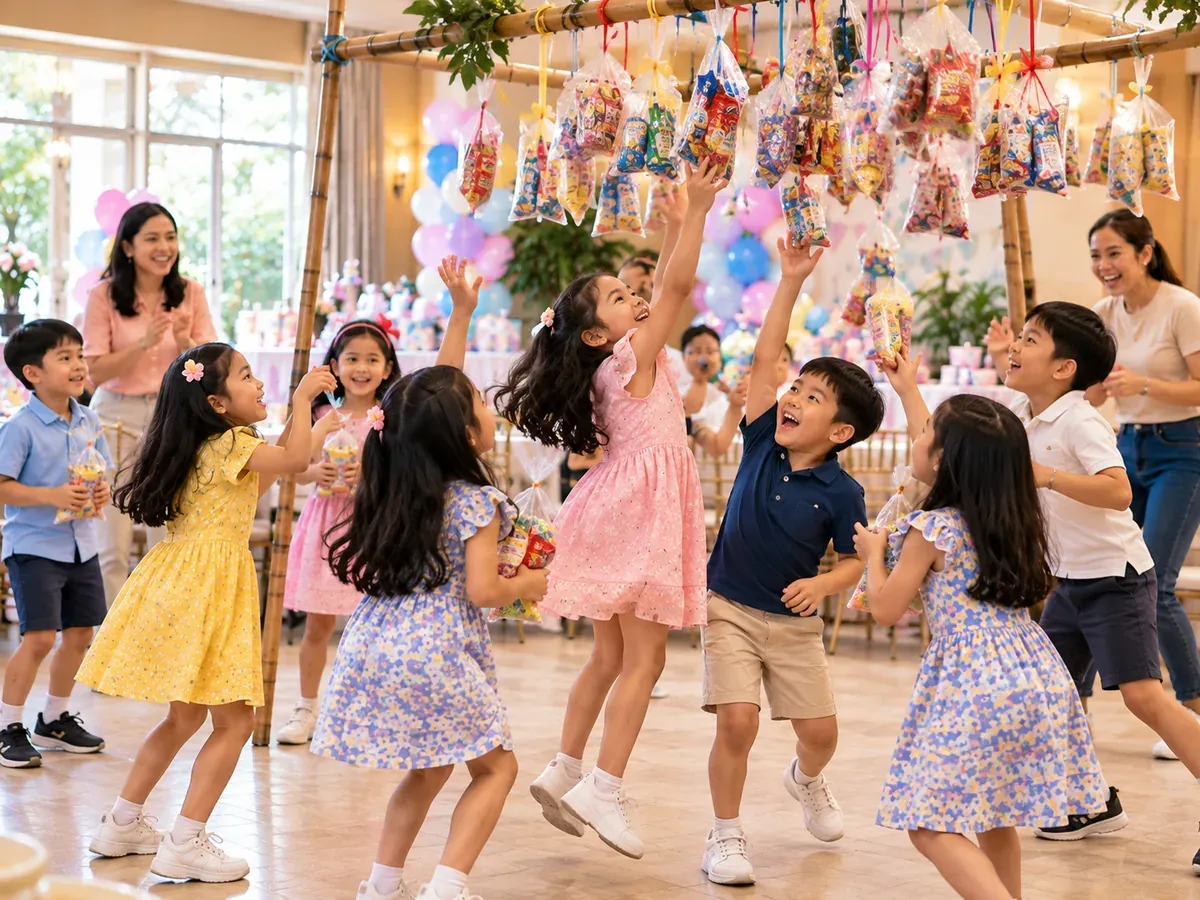
It is different from Hampas or Pukpok Palayok, where a blindfolded player tries to strike a hanging clay pot. Pabitin is a reaching game. Children do not use a stick and should not be blindfolded.
Best for: a feature moment at a Filipino children’s party when the venue permits a properly supported hanging frame and adults can manage the group closely.
You need: a purpose-built lightweight frame, lightweight prizes, a secure overhead support or venue-approved rigging point, and adults to control the frame and children.
Setup
Attach lightweight prizes securely enough to stay on the frame before play but easy enough for children to remove by hand. Check the venue’s rules before hanging anything. Clear the area underneath and around the frame. Decide how many children will join each round instead of automatically putting the entire party underneath at once.
How to play
- Bring the first group into the marked play area.
- Hold the frame above normal reach while children get into position.
- The adult controlling the line lowers the frame into reach.
- Children reach up by hand and try to take a prize.
- The adult may gently raise and lower the frame to keep the traditional challenge, but should not swing it into children.
- End the round once the allotted prizes are taken or the host calls time.
- Reset as needed for the next group.
Basic rules
Hands only. No climbing on chairs, tables or another person. No pulling down on the whole frame. No pushing, tackling or grabbing prizes from another child’s hands.
Gentler version
For younger children or a group where crowding would be difficult, keep the frame lower and steadier, use smaller groups, or let children take turns approaching the frame.
Adult tips
Assign one adult to control the frame and at least one adult to watch the children. Keep siblings and spectators outside the active area until their turn. Choose lightweight prizes appropriate to the children attending and follow manufacturer age guidance for small items.
Watch out for
Do not hang the frame from an improvised point that has not been checked. Keep hard, sharp, heavy or breakable prizes off the frame. Stop the round if children begin piling into one another.
Mechanics visual: lightweight prize frame above the group → adult lowers it → children reach by hand → frame rises again. No blindfold. No stick.
Pabitin is a reaching game. Children stay on the floor while an adult controls a lightweight prize frame.
- 1Form a small group
Use only a few children per round so they have room to reach safely.
- 2Adult controls the frame
Lower and raise the lightweight frame from a safe position.
- 3Reach by hand only
Children stay on the floor and take lightweight prizes with their hands.
- 4Clear and reset
Pause before the next group enters and redistribute prizes if needed.
5. Sack Race / Karera ng Sako
A sack race is straightforward and energetic: players stand inside sacks and hop toward a finish line.
Best for: covered courts, gardens or other open areas with a flat surface.
You need: sturdy sacks sized for the players, a clear start line and finish line, and enough room between lanes.
Setup
Mark a short course on a level surface. Check the ground for wet patches, holes, loose cords or obstacles. Give each player enough side-to-side space so they are not colliding as they hop.
How to play
- Each player steps into a sack and holds the top edge with both hands.
- Players line up behind the start line.
- On the host’s signal, everyone hops toward the finish.
- The first player to cross the finish line according to the agreed rule wins the race.
- For larger groups, run heats rather than crowding everyone into one race.
Basic rules
Players stay in their own lane or general path. No pulling another person’s sack, blocking, pushing or diving across the finish.
Team relay version
Divide players into teams. One child completes the course, returns or hands off at a marked point, and the next teammate goes. Keep the course short enough that waiting children are not standing around too long.
Adult tips
Let children practice getting into the sack and making a few hops before the race. If the surface is hard or slippery, choose another game.
Watch out for
Falling is part of the risk of sack racing, so avoid steep slopes, rough pavement and crowded lanes. Do not use oversized bags that cover a child’s face or prevent them from getting their hands free.
Mechanics visual: players inside sacks at start line → hop forward in separate lanes → cross finish line.
Keep the race easy to understand with a clear start, separated lanes and a visible finish.
- 1Line up
Each player stands behind the start line with both feet inside the sack.
- 2Hop in your lane
Players move forward without crossing into another child’s path.
- 3Finish safely
The round ends when the player or team crosses the finish marker under the agreed rule.
6. The Boat Is Sinking
The Boat Is Sinking is a grouping game. Players move around while the host gives a number, then quickly form groups of that size.
Best for: medium or larger groups with enough open floor space.
You need: a host and a clear play boundary.
How to play
- Ask everyone to walk or move around the play area.
- The host calls, “The boat is sinking! Group yourselves into four,” or another number.
- Players quickly form groups of exactly that size.
- Once groups are formed, the host checks them.
- Traditional versions may eliminate players who are left over. For children’s parties, a reset-every-round version is usually easier to manage.
- Repeat with different group sizes.
No-elimination version
Nobody is out. If the number does not divide evenly, the host or helper can join a group, or the host simply says “reset” and starts the next round. Another version asks groups to make a shape or pose after forming.
Adult tips
Use group numbers that make sense for the number of children present. Keep the host’s tone playful so children who are temporarily left without a group do not feel singled out.
Watch out for
Do not let children drag or pull another child into a group. If the room is small, have them walk instead of run.
Mechanics visual: players spread out → host calls a number → players form groups → reset and repeat.
Players move freely until the host calls a group size, then quickly form groups of that exact number.
- 1Spread out
Children move around a clear open area without clustering too early.
- 2Call a group size
The host announces a number such as 3, 4 or 6.
- 3Form groups
Children gather into groups of exactly that number without pulling anyone.
- 4Reset
Send everyone back out and call another number. A no-elimination version keeps all players in.
7. Newspaper Dance / Floor-Marker Dance
Newspaper Dance is often played by pairs who dance around or on a sheet of newspaper. After each round, the paper becomes smaller. That traditional shrinking version can become unstable, so a safer party version uses large floor markers or stops shrinking before balance becomes difficult.
Best for: indoor parties where you want a music game with a little teamwork.
You need: large sheets of paper, non-slip mats or clearly marked floor spots, plus music.
How to play
- Give each pair or team one large floor marker.
- Start the music and let players dance beside or around it.
- When the music stops, everyone must place both feet inside the marked area.
- In the traditional version, fold the newspaper for later rounds.
- Stop reducing the area before children have to stand on one foot, climb on one another or use unsafe balancing tricks.
- Continue for a fixed number of rounds or award points for completing each round.
No-elimination version
Instead of making the paper smaller, change the prompt: one hand on the marker, two feet on the marker, everyone touching the edge, or a team pose around it.
Watch out for
Paper can slide on polished floors. Do not encourage lifting another child, standing on someone’s feet or squeezing several children onto a tiny sheet.
Mechanics visual: pairs move while music plays → music stops → feet inside safe floor marker → next round.
Use flat non-slip markers so pairs or small groups have a clear target when the music stops.
- 1Assign markers
Give each pair or team one flat marker on a clear floor.
- 2Dance nearby
Children move while the music plays but stay aware of their own marker.
- 3Stop and step in
When the music stops, both players place their feet safely inside the marker.
Traditional Larong Pinoy
8. Patintero
Patintero is a traditional Filipino team game played on a marked rectangular grid. One team guards the lines while the other team tries to cross the grid and return without being tagged.
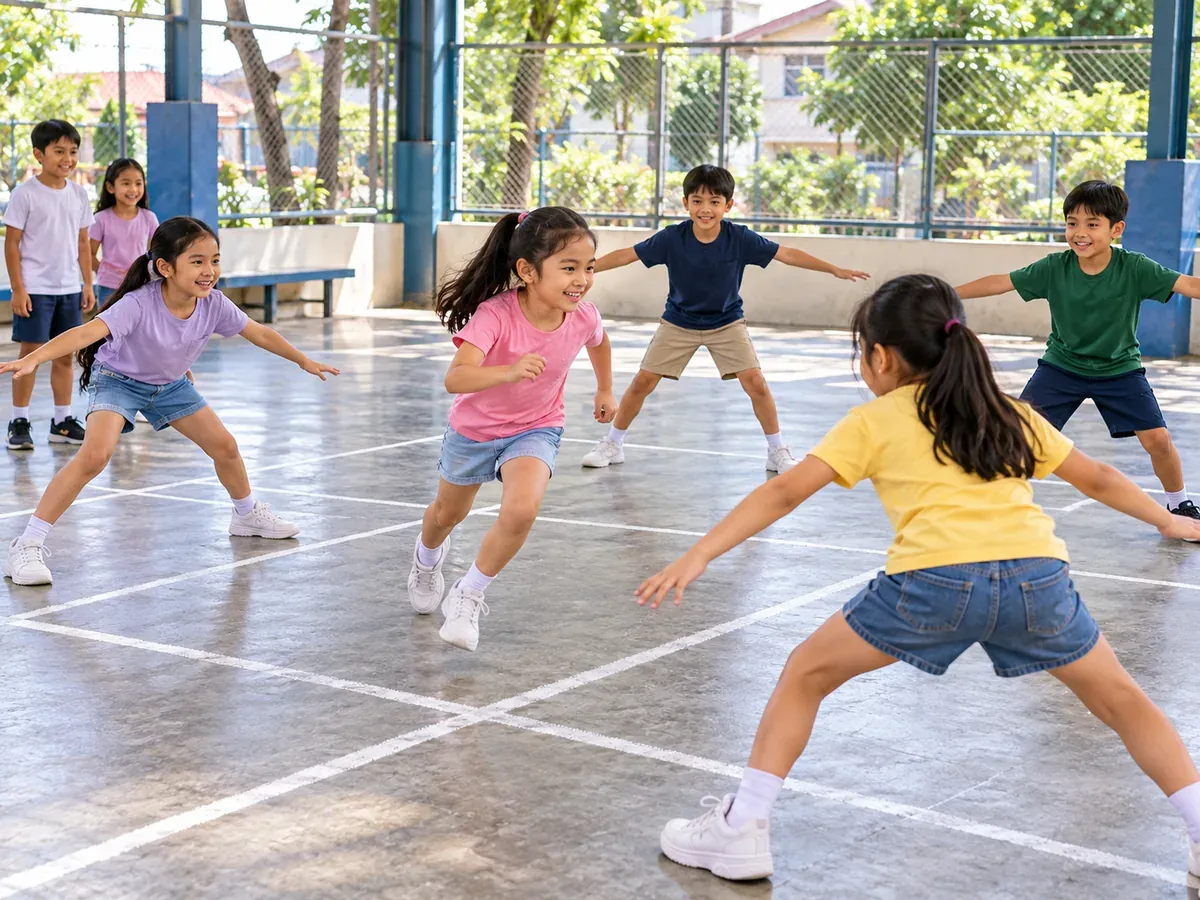
Best for: older children who understand team rules and have a large, clear outdoor or covered-court space.
You need: chalk, removable floor tape or another venue-approved way to mark the court.
Setup
Mark a simple rectangle divided into lanes. One team becomes the line guards; the other becomes the runners. Explain the exact boundaries before the first round.
How to play
- Guards stand on the marked lines and move along those lines.
- Runners start outside one end of the grid.
- On the signal, runners try to cross each guarded line and reach the far end.
- They then try to return to the starting side.
- A runner tagged according to the agreed rule is out for that turn or the teams switch after the agreed number of tags.
- Rotate roles so both teams get to guard and run.
Party-friendly version
Use a smaller court, fewer guards and short timed rounds. Instead of eliminating runners one by one, give the running team a point for each successful crossing and reset everyone after a tag.
Adult tips
Demonstrate where guards may move and what counts as a tag. A simple court and short round are better for a party than trying to reproduce every neighborhood variation.
Watch out for
This is a movement game. Keep the court away from parked vehicles, food areas, stairs and hard obstacles. No tackling, grabbing clothes or blocking with the body.
Mechanics visual: marked grid → guards stay on lines → runners cross lanes → runners try to reach the far end and return.
The grid matters: guards defend from the lines while runners move through the open sections and try to return.
- 1Mark the grid
Use a clear rectangular court with crossing guard lines.
- 2Assign guards
Guards move only along their assigned lines.
- 3Send the runners
Runners cross open lanes while avoiding a clear tag.
- 4Return and score
A successful run usually means reaching the far end and returning under the agreed rules.
9. Agawang Panyo
Agawang Panyo is a team game in which matching players from two sides race toward an object placed or held in the center.
Best for: school-age children, team play and open spaces.
You need: a handkerchief or other soft visible marker, two team lines and one adult referee.
Setup
Divide the children into two teams and line them up facing each other with the center point between them. Give each player on both teams a matching number.
How to play
- The referee stands at the center holding or placing the panyo.
- The referee calls a number.
- The player with that number from each team moves toward the center.
- One player tries to take the panyo and return to the team’s line.
- The other player tries to tag the runner before the runner reaches safety.
- Award a point according to the rule explained before play, then reset and call another number.
Party-friendly version
For younger or mixed groups, remove the chase. The first player to pick up or touch the center marker earns the point, then both walk back and reset.
Watch out for
No tackling, pushing, body-blocking or diving for the panyo. Give the teams enough distance from walls and furniture.
Mechanics visual: two team lines → matching numbers called → two players approach center marker → one returns toward team line.
Matching players from opposite teams approach the center only after the host calls their number.
- 1Number both teams
Give matching numbers to players on each side.
- 2Call one number
Only the two matching players move toward the center.
- 3Take the panyo
One player grabs the soft marker while the other prepares to tag.
- 4Return to your line
The runner tries to reach the team line before being tagged.
10. Tumbang Preso
Tumbang Preso is a traditional Filipino game commonly played with a can and slippers or other throwing objects. For a children’s party, it needs a controlled throwing lane and a simplified rule set.
Best for: outdoor or covered open areas where throwing can be separated from spectators.
You need: a lightweight can or target, soft or suitable throwing markers, a throw line and a clear retrieval rule.
Party-friendly setup
Place the target on the ground at a comfortable distance. Mark one throw line. Keep everyone who is not throwing behind the line. Use one adult to manage turns and retrieval.
How to play
- One child at a time throws from behind the line and tries to knock over the target.
- After the throw, the adult calls whether the player may retrieve the throwing marker.
- Reset the target after a hit.
- Award one point per hit or simply give each child a fixed number of turns.
- Rotate through the group.
Why simplify it for a party?
Neighborhood versions often include a guard or “it” player and more complex chasing and retrieval mechanics. Those can be fun when children already know the game, but a birthday party often has mixed ages and limited time. A target-throw version keeps the recognizable skill while being easier to supervise.
Watch out for
Use a clearly controlled throw direction. No one enters the throwing lane until the host says it is clear. Avoid hard, sharp or heavy projectiles.
Mechanics visual: player behind throw line → target ahead → throw toward target → adult-controlled retrieval and reset.
For a party-friendly version, use a soft marker and an adult-controlled target/reset zone.
- 1Stand behind the line
Only the current thrower enters the throwing position.
- 2Throw at the target
Use a soft marker and a controlled lightweight target.
- 3Adult resets
The host clears and resets the target before the next throw.
- 4Retrieve only when clear
Children wait until the host says the lane is safe.
11. Piko
Piko is the Filipino version of a hopscotch-style game. Players move through a marked pattern on the ground, usually hopping through numbered or divided spaces.
Best for: a small number of players at a time, outdoor or covered spaces and children comfortable with hopping.
You need: chalk or removable tape, a simple piko pattern and an optional flat marker.
Setup
Draw or tape a simple piko layout on a flat surface. If the venue does not allow floor markings, use removable floor spots instead.
How to play
- A player starts behind the first box.
- The player moves through the pattern, hopping on single spaces and using two feet where the layout has side-by-side spaces.
- If using a marker, toss it gently into the target box and skip that box on the way through.
- Turn around at the end and return through the pattern.
- Complete the round without stepping on a boundary or losing balance.
- Pass the turn to the next player.
Easier version
Remove the throwing marker and simply follow the hopping pattern. You can also make wider boxes or allow stepping instead of hopping.
Watch out for
Keep the surface dry and unobstructed. Do not make the pattern so long that children waiting for a turn lose interest.
Mechanics visual: marked piko boxes → player follows hop/step path → turn at end → return.
The player progresses through a marked hopscotch-style court while avoiding the marker square and boundary lines.
- 1Throw the marker
Place the marker in the next target box without touching a line.
- 2Follow the hop pattern
Hop or step through the court while skipping the marked box.
- 3Turn and return
Come back through the court and pick up the marker before finishing the turn.
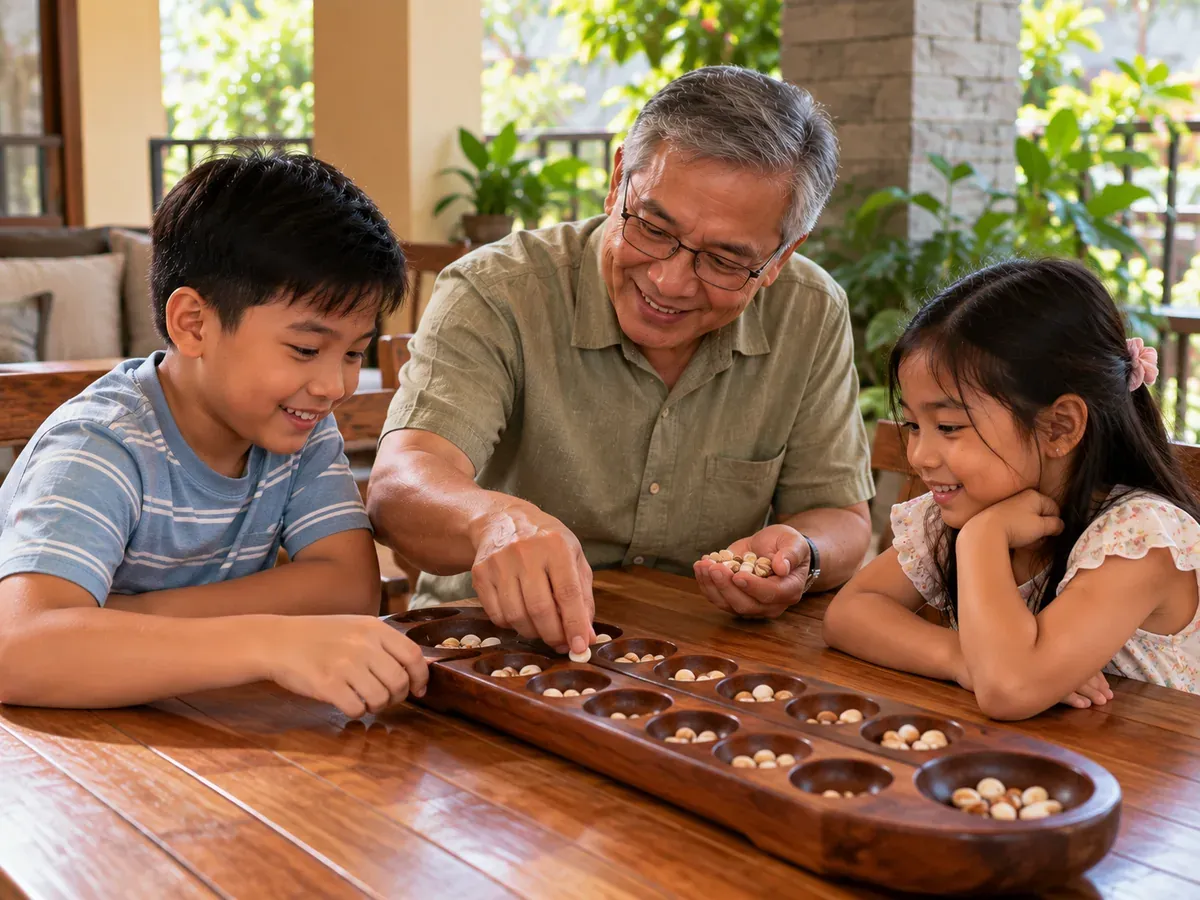
12. Sungka
Sungka is a traditional Filipino board game played with a wooden board containing rows of small holes and two larger stores. It is a quieter option rather than a whole-group party game.
Best for: a calm side activity, older children who want a break from active games, or a Filipino-games corner.
You need: a Sungka board and suitable counters.
How to play
Sungka has established rules and local variations, so if the children already know the game, let them use the version familiar to them. For a party, the simplest approach is to seat two players with an adult or older helper who knows the rules and can guide turns.
A typical turn involves taking all counters from one of the player’s small holes and distributing them one by one around the board, including the player’s own store according to the agreed rules. Play continues until the round ends and counters are counted.
Party use
Treat Sungka as a side station rather than trying to make twenty children watch one match. A small sign or adult helper can invite pairs to play while other activities are happening.
Watch out for
Sungka uses small counters. Keep them away from very young children who may put small pieces in their mouths, and follow the product’s age guidance.
Mechanics visual: two-player board → pick counters from one hole → distribute one by one → collect according to the agreed rules.
Sungka is easier to learn by watching one complete move before starting the match.
- 1Choose one occupied house
Start from a house on your side of the board.
- 2Pick up all counters
Take every counter from that house into your hand.
- 3Sow one by one
Drop one counter into each next house in sequence under the chosen rules.
- 4Continue by the rules
The ending position of the last counter determines what happens next.
13. Luksong Lubid / Jump-Rope Challenges
Jump-rope games are familiar in Filipino play and can work as a simple party station when you have enough open space.
Best for: outdoor or covered areas with a flat surface.
You need: a suitable jump rope and one or two adults or older helpers.
How to play
For a simple group version, two helpers turn a long rope while one child enters and completes a set number of jumps. Then the next player takes a turn.
For an easier version, keep the rope low and still so children step over it, or swing it gently along the floor for children to time their step.
Rules
One child enters the active rope area at a time unless the group already knows a multi-player variation. Waiting players stay behind a marked line.
Watch out for
Keep faces and spectators away from the turning rope. Do not use the rope for pulling games, tying players or wrapping around the body.
Mechanics visual: helpers control rope → one player enters marked area → completes a short jump challenge → exits for next player.
Modern Party Games Kids Can Try
14. Treasure Hunt / Scavenger Hunt
A treasure hunt sends children looking for clues, objects or checkpoints. It can be simple enough for a home party or expanded across a larger function room.
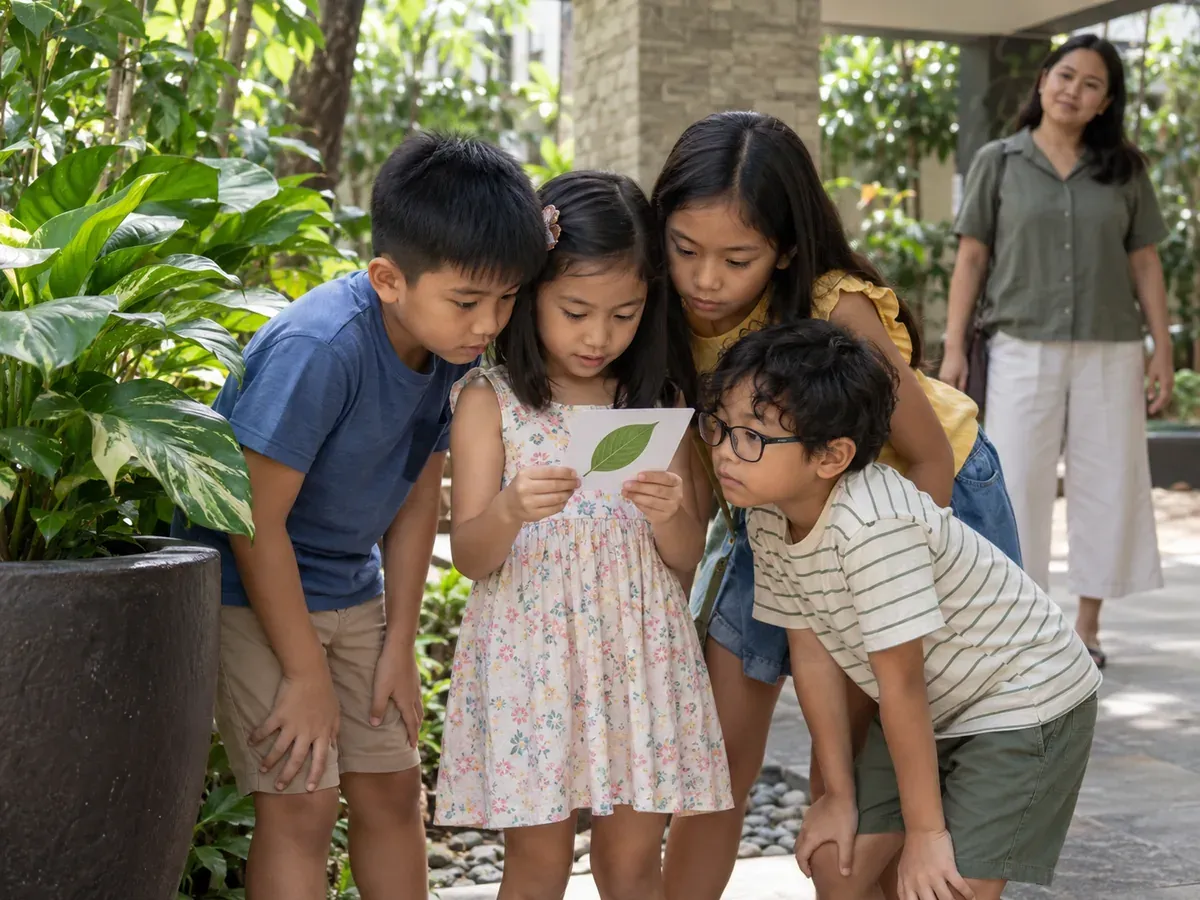
Best for: themed parties, team play and children who enjoy solving or searching.
You need: clues or picture cards, safe hiding places and a defined search area.
Setup
Choose the search boundary first. Hide clues only in areas children are allowed to enter. Use picture clues for children who are not yet confident readers.
How to play
- Give each child or team the first clue.
- The clue points to a safe location or object.
- Finding it reveals the next clue.
- Continue through a short chain of clues.
- The final clue leads to the finish, a shared surprise or the next party activity.
Scavenger-list version
Instead of a clue chain, give each team a short list of things to find or spot: something round, something green, a picture of an animal, or a prepared card hidden in a known area.
No-elimination version
Make the whole group one team. Everyone contributes to solving the clues and nobody is racing against another child.
Adult tips
Walk the route yourself before the party. Make sure clues cannot lead children into kitchens, stairs, parking areas, staff spaces or outside the venue.
Watch out for
Do not hide clues inside personal bags, behind heavy furniture or in places that require climbing. Keep the hunt short enough that it still feels like a party game.
Mechanics visual: first clue → safe search zone → next clue/checkpoint → final shared finish.
Keep the hunt inside a defined safe area and make every clue point to an approved checkpoint.
- 1Start with one clue
Give the team a picture, riddle or simple direction they can solve together.
- 2Move to the checkpoint
Children stay together and walk only through approved party areas.
- 3Solve the next clue
Each checkpoint reveals the next step instead of sending children to search randomly.
- 4Finish together
End at one final envelope, prize box or shared reveal.
15. Mini Obstacle Course
A mini obstacle course combines several simple movements into one route: walk around a cone, step over a low marker, crawl under a safe arch, toss a soft item into a basket, then finish.
Best for: energetic parties with a medium or large open area.
You need: soft, stable props chosen for the venue.
Setup
Build a short route with three to five stations. Test every station yourself and remove anything that tips, slides or creates a hard fall.
How to play
- Show the entire route before anyone starts.
- One child begins at the start line.
- Complete each station in order.
- Finish at the marked end point.
- Reset any moved props before the next player.
- Run it as individual turns, a team relay or simply a fun circuit without timing.
Easier version
Use walking, stepping around cones, touching colored markers and tossing a soft beanbag. There is no need for climbing equipment.
Watch out for
Avoid unstable chairs, high jumps, blindfolds, hard edges and routes crossing busy walkways.
Mechanics visual: start → weave/step station → soft toss station → finish.
Use a short sequence of easy stations so children can see the whole route before starting.
- 1Weave
Move around cones or markers without racing another child in the same lane.
- 2Step through
Use hoops or floor markers for a simple balance or footwork station.
- 3Soft toss
Throw a beanbag or soft item into a wide target.
- 4Finish
Cross the marker, then clear the lane before the next player starts.
16. Cup Stack Relay
Cup Stack Relay is a quick challenge using lightweight cups. Players build a simple stack and return the cups to the starting arrangement before the next turn.
Best for: indoor tables, small teams and short rounds.
You need: identical lightweight cups and a stable table or floor mat.
How to play
- Give each player or team the same number of cups.
- On the signal, build the agreed pattern, such as a small pyramid.
- Once the stack is complete, collapse or return the cups to one stack.
- The round ends when the cups are back in the required starting arrangement.
- For a relay, the next teammate begins only after the reset.
Party-friendly scoring
Time each team only if the children enjoy competition. Otherwise, give everyone one attempt and celebrate a clean completion.
Watch out for
Do not use glass or hard breakable cups. Keep drinks separate from the game table.
Mechanics visual: cups in one stack → build simple pyramid → return to one stack → next player.
A repeatable stack-and-reset pattern makes the relay easy for children to understand.
- 1Start with one stack
Place the cups together at the station.
- 2Build the pyramid
Use a simple 3–2–1 stack or another age-appropriate shape.
- 3Collapse the cups
Return every cup to one neat stack.
- 4Tag the next player
Only then does the next teammate start.
17. Minute-to-Win-It Style Challenges
“Minute-to-Win-It” style party games are short challenges using simple objects. The useful idea is the format: one small task, one short round, quick reset.
Best for: older children, team stations and parties that want several quick challenges instead of one long game.
Good challenge examples
- stack a set number of plastic cups;
- move soft pom-poms between bowls using a spoon;
- toss soft balls into a basket from a marked line;
- transfer large safe objects from one container to another;
- build a simple block tower and take it down.
How to run it
- Demonstrate the task.
- Give every player the same starting setup.
- Start a short timer or simply use one music track.
- Players complete as much of the challenge as they can.
- Reset the station before the next turn.
Safety filter
Skip challenges that depend on putting food or small objects in the mouth, rapid eating, sharp tools, glass, hard projectiles or anything that becomes risky when children rush.
Mechanics visual: identical starting setup → host demonstrates one task → short timed attempt → reset.
18. Mystery Box Guessing Game
In a Mystery Box game, children try to identify an object they cannot see clearly.
Best for: quieter indoor parties, small groups and children who enjoy guessing games.
You need: an opaque box or bag and a set of safe, familiar objects.
How to play
- Place one object inside the box.
- A player feels the object through an opening or reaches into the bag without looking.
- Give the player a short time to guess.
- Reveal the object.
- Rotate to the next child with a new object.
Team version
Let the whole team ask yes-or-no questions while one player touches the object.
Good object choices
Use clean, blunt, easy-to-handle items with clearly different textures or shapes. Avoid tiny pieces, food allergens, messy items and anything sharp.
Mechanics visual: hidden object in box → player feels without looking → player guesses → reveal.
19. Pass the Message / Whisper Game
Pass the Message is a quiet group game in which a phrase travels from one person to another by whispering.
Best for: older children who can listen and repeat a short phrase, or as a calmer game after active play.
You need: prepared short phrases.
How to play
- Seat or line up each team.
- Whisper the phrase once to the first player.
- That player whispers what they heard to the next person.
- Continue until the last player.
- The last player says the message aloud.
- Compare it with the original phrase.
Rules
No repeating the message several times unless you decide that is part of the easier version. No shouting clues down the line.
Easier version
Use a simple phrase, picture sequence or three-word message. For children who may not hear a whisper well, use a “draw the message” or gesture version instead.
Mechanics visual: host gives message to first player → message travels person to person → last player reveals it.
20. Mini Clue Hunt / Escape-Style Challenge
This is a compact puzzle game inspired by escape-room style play without locking anyone in a room. Children solve two or three simple clues to open a final envelope or discover a code.
Best for: older children, small teams and themed parties.
You need: printed or picture clues, envelopes and a clear finish.
How to play
- Give the team the first puzzle or picture clue.
- The answer points to the second clue.
- The second clue gives a simple code, word or location.
- The final clue reveals the finish.
- Keep the whole activity short enough to fit naturally into the party.
Party-friendly rule
No doors are locked and no furniture needs to be moved. Every clue should be solvable using the provided materials and the allowed area.
Watch out for
Avoid clues that require internet access, private information, hidden electrical areas or climbing.
Mechanics visual: clue 1 → answer → clue 2 → simple code/final envelope.
21. Relay Stations
Relay Stations let you build a custom team race using simple tasks rather than one specific traditional game.
Best for: medium or large groups with open space.
You need: two or more identical station sets.
Example relay
- Walk around a cone.
- Carry a soft beanbag to a basket.
- Stack three cups.
- Return to the team.
- Tag the next player.
How to play
Divide children into teams. One player from each team completes the same short route, returns to the line and releases the next teammate. Continue until everyone has had a turn or for a fixed time.
No-pressure version
Do not rank the teams. Give each team a goal such as “complete the route with everyone taking one turn.”
Watch out for
Avoid spoon races with small food items for very young children, hard objects that can be thrown, or stations that create traffic crossing between teams.
Mechanics visual: team line → station 1 → station 2 → return/tag → next teammate.
Global Party Favorites
22. Pass the Parcel
Pass the Parcel is popular in many countries and works well for a Filipino birthday party too. A wrapped parcel moves around a circle while music plays. When the music stops, the child holding it opens one layer.
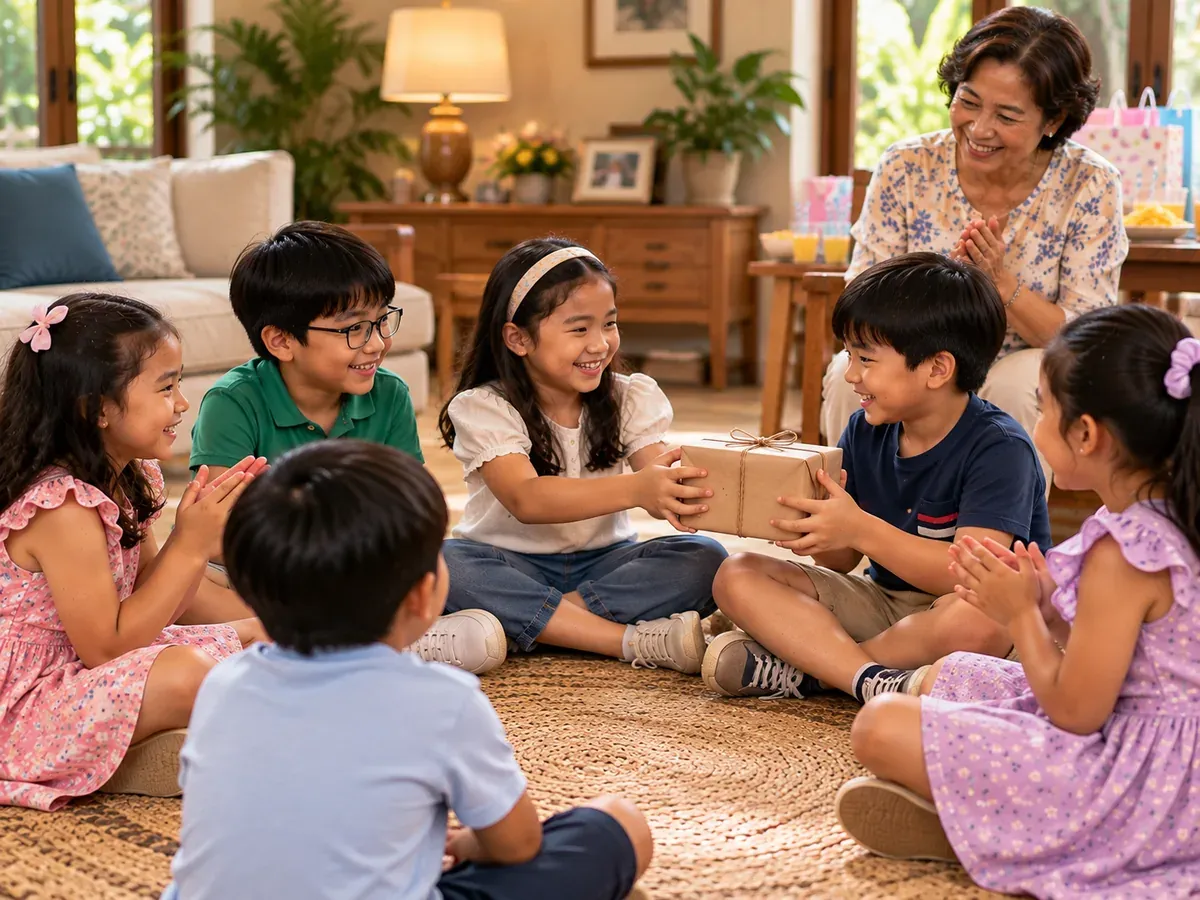
Best for: indoor parties, younger groups and parties that want a calmer music game.
You need: one parcel wrapped in several layers, music and a seated circle.
Setup
Wrap the parcel in several easy-to-open layers. You can place a small paper prompt, sticker or simple surprise between selected layers. If using a final prize, make the rules clear so children understand that not every layer has a prize.
How to play
- Children sit in a circle.
- Start the music and pass the parcel around.
- Stop the music.
- The child holding the parcel opens one layer.
- Start the music and continue passing.
- Repeat until the final layer is opened.
More inclusive version
Place a simple activity prompt in each layer—make a funny face, name an animal, choose the next song—rather than turning every layer into a prize contest.
Watch out for
Use wrapping that children can open without scissors. Keep small prize pieces age-appropriate.
Mechanics visual: parcel moves around circle → music stops → one layer opens → music restarts.
The parcel keeps moving while music plays. The child holding it when music stops opens one layer.
- 1Sit in a circle
Keep the passing path short and clear.
- 2Pass the parcel
Move it from child to child while the music plays.
- 3Stop the music
The child holding the parcel opens exactly one layer.
- 4Resume
Restart the music and continue until the final layer is opened.
23. Simon Says
Simon Says is a listening-and-movement game. Players follow a command only when it begins with “Simon says.”
Best for: low-prep parties, small spaces and mixed groups.
You need: only a host.
How to play
- The host says, “Simon says touch your head.”
- Everyone follows the command.
- The host then gives another command.
- If the host says “touch your knees” without “Simon says,” players should stay still.
- Traditional versions eliminate players who make a mistake. At a children’s party, you can simply keep everyone playing.
No-elimination version
Give the group a collective goal: can everyone complete ten commands together? Mistakes are funny, not disqualifying.
Adult tips
Start slowly, then vary the pace. Use movements that are possible in the available space.
Mechanics visual: host gives command → “Simon says” means do it → no “Simon says” means stay still.
24. Charades / Picture Charades
Charades asks one player to act out a word or idea while others guess. Picture Charades uses cards with images instead of written words.
Best for: mixed ages, indoor parties and groups that like acting or guessing.
You need: prepared word or picture cards.
How to play
- A player draws one card.
- Without saying the answer, the player acts it out.
- The team or group guesses.
- Set a short round time if you want.
- Rotate to the next player.
Good categories
Animals, simple actions, familiar objects, story characters or party-theme words. Keep prompts appropriate to the children attending.
Easier version
Use picture cards and allow one simple gesture hint from the host. For shy children, let two players act together.
Watch out for
Do not force a child to perform alone. Let children pass and choose another role if they prefer.
Mechanics visual: player sees secret card → acts without saying word → group guesses → reveal.
25. Bingo
Bingo is useful when you want a calmer game that can include children and adults.
Best for: seated indoor parties, mixed-age groups and a break between active games.
You need: bingo cards, a caller and safe markers such as pencils, crayons, stickers or stamps.
How to play
- Give each player a bingo card.
- The caller announces or shows one item at a time.
- Players mark matching spaces.
- The first player to complete the agreed pattern calls “Bingo.”
- The host checks the card before confirming the win.
Party versions
Use numbers, animals, colors, party icons or theme pictures. Picture Bingo works well when some children are not reading yet.
Watch out for
Avoid tiny loose markers around very young children. Do not make the game so long that attention drops; a simple row or short pattern is enough.
Mechanics visual: caller reveals item → players find match → mark card → complete agreed pattern.
26. Pin the Tail / Pin the Object
This classic party-game format can be changed to fit almost any theme: pin the tail, crown, star, fin, wheel, badge or another paper shape onto a large poster.
Best for: themed indoor parties and small groups taking turns.
You need: a large poster, reusable paper pieces, removable adhesive and an optional eye cover.
How to play
- Mount the poster at a comfortable height.
- Give the player one paper piece with removable adhesive.
- If the player is comfortable, use an eye cover. Spinning is not necessary.
- Guide the player to the start position.
- The player walks a short straight distance and places the piece.
- Mark the result and give the next child a turn.
Easier version
Skip the eye cover and let younger children place the piece from a marked distance or after looking for only a few seconds.
Watch out for
Keep the route clear. Do not spin children until they are dizzy. Use soft paper pieces and removable adhesive rather than pins or sharp fasteners.
Mechanics visual: player receives paper piece → optional eye cover → short clear path → place piece on poster.
Keep the approach short and obstacle-free. An eye cover is optional, especially for younger children.
- 1Give one paper piece
Use removable adhesive and a lightweight paper object.
- 2Set the start point
Mark a short straight path with nothing to trip over.
- 3Approach the poster
Use an optional eye cover only if the child is comfortable.
- 4Place the piece
Stick it once, then step away for the next player.
27. Duck Duck Goose
Duck Duck Goose is a circle game in which one child walks around the outside, taps players in turn and chooses one to chase.
Best for: children who already understand chasing games and have a clear open floor or lawn.
You need: enough space for a seated circle and a running path around it.
How to play
- Children sit in a circle.
- One player walks around the outside, gently tapping each child and saying “duck.”
- The player chooses someone by saying “goose.”
- The chosen child stands and follows around the circle.
- The first player tries to reach the open seat.
- The next round begins with the agreed player as the caller.
Gentler version
Use fast walking instead of running, or make the chosen player copy a funny movement around the circle rather than chase.
Watch out for
Keep the outside path clear and wide enough. No hard tapping, pulling or cutting through the seated circle.
Mechanics visual: seated circle → caller walks outside tapping → “goose” selected → short chase/walk to open spot.
28. Limbo
Limbo asks players to pass under a horizontal bar or ribbon without touching it while leaning backward.
Best for: parties with open space and children comfortable with balance.
You need: a lightweight limbo bar or soft ribbon held by two adults.
How to play
- Adults hold the bar at an easy starting height.
- Players take turns moving underneath without touching it.
- After everyone has tried, lower the bar slightly if the group wants another round.
- Stop lowering before the movement becomes uncomfortable or unsafe.
No-elimination version
Keep the bar at a comfortable height and change the movement: walk under, dance under, or travel as a team. Nobody has to prove how low they can go.
Watch out for
Never use a heavy rigid pole that could injure a child if dropped. Do not pressure children with back, balance or mobility limitations to participate in the standard movement.
Mechanics visual: lightweight bar held by adults → player approaches → passes under at comfortable height → reset.
More Game Ideas to Keep in Your Back Pocket
You do not need to run every idea below. They are useful backups when you need something short, simple or different.
Picture Hunt: give children a small sheet of pictures and ask them to spot matching items around the allowed area.
Color Corners: assign a color to each corner or floor marker. Call a color and have children move to that area without running.
Follow the Leader: one child or adult leads a short sequence of safe movements for everyone to copy.
Floor Is Lava — party version: use large safe floor markers as “islands” and have children step between them. Do not use furniture or climbing.
Drawing Relay: one player draws a clue, then the next teammate adds to it or guesses.
Story Chain: each child adds one sentence to a shared silly story.
Guess the Sound: play or make familiar sounds and let children guess what they are.
Would You Rather — move to a side: mark two sides of the room for simple choices such as cats or dogs, beach or mountains, pancakes or waffles. Keep the choices light and inclusive.
How to Choose Between Classic, Modern and Global Games
A good lineup does not need one game from every category.
Choose classic Filipino party games when you want familiar energy that parents, titos, titas and grandparents will recognize. Bring Me, Stop Dance and Pabitin can make a party feel immediately familiar.
Choose Larong Pinoy when you have the right space and want children to experience traditional Filipino games. Patintero, Piko and Tumbang Preso are better when the venue allows floor markings or a clear play area.
Choose modern party challenges when you want something easy to theme or customize. Treasure Hunts, Cup Stack Relays and short challenge stations work especially well when you want several small activities.
Choose global favorites when you want a format that is easy to explain and easy to adapt. Pass the Parcel, Simon Says, Charades and Bingo can work in many party sizes and indoor setups.
The best lineup is the one that matches your children and venue—not the one with the longest list.
How Many Games Should You Prepare?
There is no universal number. For many parties, a short planned lineup plus one backup is easier to host than a long program that keeps children waiting.
A simple example might be:
- Easy opener: Stop Dance or Simon Says.
- Main active game: Sack Race, Patintero or Mini Obstacle Course.
- Feature game: Pabitin, Treasure Hunt or Pass the Parcel.
- Quieter follow-up: Bingo, Charades or Mystery Box.
- Backup: Bring Me, ready only if you need it.
This is an example, not a required order. If the children are enjoying one activity, you do not have to stop just because another game was written on the program.
Mechanics visual: opener → active game → feature game → quieter game → backup only if needed.
A balanced program does not need nonstop games. Use a few different energy levels and keep one backup.
- 1Easy opener
Start with something simple that lets children settle in.
- 2Active game
Move into a higher-energy game while attention is strong.
- 3Feature game
Use the game that needs the most space, setup or host attention.
- 4Quieter game
Bring the group back down before food, cake or the next program block.
- 5Backup only if needed
Keep one extra game ready instead of forcing too many activities into the schedule.
Match Food and Service to the Party Format
Games run more smoothly when the food plan fits the venue and the program. You do not need the same service format for every children’s party.
Shareable dishes with flexible serving
If adults can set out the food and guests are comfortable sharing dishes, party trays and food trays in Manila can keep the meal side simple without turning the party into a full buffet-service setup.
Useful when games happen before the meal and you want food ready for a clear break in the program.
Individual portions that are easy to distribute
When children need to eat at their seats or the venue has little room for a serving table, individual packed meals in Manila can be easier to hand out and account for per guest.
This can work well for school celebrations, field-day style activities and programs with a fixed meal break.
Food, setup and service handled together
If you need a more complete event setup rather than a self-serve food format, compare Jojie's kiddie party catering options and plan the game blocks around the meal and service flow.
Keep active games away from buffet queues, hot food, glassware and staff movement.
For smaller celebrations, another useful comparison is whether you want party trays delivery and pickup options or individually portioned packed meal delivery in Metro Manila. Choose the format that makes the venue easier to manage; the games page should not force one food format onto every party.
How to Host Children’s Party Games Well
The host does not need a long script. Clear instructions and a quick demonstration are usually more useful.
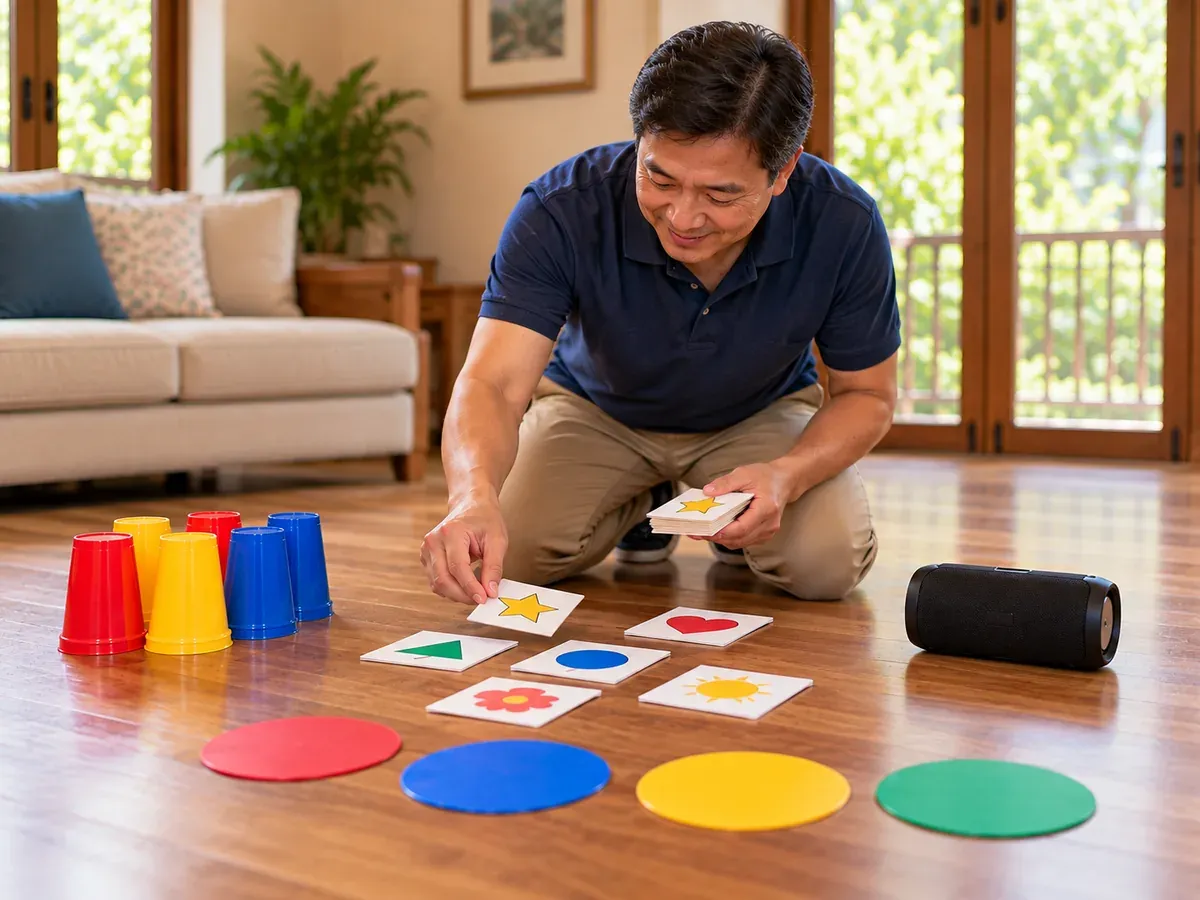
Before each game:
- gather the children where they can hear and see the host;
- explain the goal in one or two sentences;
- point out the play boundary;
- show one sample turn when the mechanics are not obvious;
- explain whether anyone sits out or whether everyone keeps playing;
- say where children should wait when it is not their turn;
- have prizes and materials ready before calling players forward.
One adult can lead the game while another handles music, props or the waiting group. For active games or larger groups, that extra helper makes the flow much easier.
If the children are clearly not in the mood for a game, change it or move on. A party program is a plan, not a contract.
Mixed Ages, Different Abilities and Children Who Do Not Want to Compete
Age is useful, but it is not the only thing that matters. Think about whether the children can understand the rule, move comfortably through the space and enjoy the level of competition.
Useful adjustments include:
- let children play in teams instead of alone;
- keep everyone in rather than eliminating players;
- allow walking instead of running;
- use a visible signal together with music or spoken cues;
- let a child have a partner or adult helper;
- use picture prompts instead of reading-heavy instructions;
- offer a quieter side activity for children who do not want the main game;
- let children pass without making it a big issue.
A game does not fail because you changed the traditional rule. If the adjustment makes the activity clearer, safer or more enjoyable for the actual children attending, it is doing its job.
Match the Games to the Actual Venue
A game that works in a covered court may not work in a condominium function room.
Before choosing a game, look at:
- the usable open floor area after tables and chairs are set up;
- doors, stairs and busy walkways;
- the cake, buffet, drinks and serving area;
- slippery or uneven flooring;
- ceiling height and whether hanging props are allowed;
- rules about tape, chalk, music or decorations;
- where waiting children and adults will stand.
Keep active games away from hot food, serving equipment, glassware and the main guest walkway. Check venue rules before planning Pabitin, floor markings or anything that needs to be attached overhead.
Prizes Are Optional
Games can work without prizes. Children may enjoy the movement, surprise and group activity on their own.
If you do use prizes, decide in advance how they will be given:
- one prize for a winner;
- small recognition for several rounds;
- team prizes;
- a shared treat after the activity;
- participation tokens for everyone.
For younger children, avoid tiny loose items that may be unsuitable for their age. Follow the product manufacturer’s age guidance.
Common Game-Day Mistakes to Avoid
Too many games. A packed game list can turn the party into one long instruction session.
Long explanations. Show one quick example instead of giving a lecture.
No clear boundary. Children should know exactly where they can move and where they should wait.
Active games beside the food. Keep races, chasing and throwing away from the buffet, drinks, cake and service area.
Every game eliminates someone. Mix competitive games with games where everyone stays involved.
Choosing by age alone. Confidence, mobility, group familiarity and the venue matter too.
Improvised risky equipment. Stable chairs, lightweight props and a clear floor are better than last-minute obstacles.
Treating Pabitin like Palayok. Pabitin is a reaching game with a hanging prize frame. It is not a blindfold-and-stick game.
Forcing participation. A child can watch, help the host, keep score or join another activity.
Planning a 7th Birthday?
A 7th birthday may include more program elements, family traditions or a larger mixed-age guest list. Keep the games section focused enough that it does not take over the whole celebration.
For the wider event flow, use our 7th Birthday Party Checklist.
Quick Game Prep Checklist
Before guests arrive, check that:
- the games fit the actual usable space;
- one adult knows the rules of each planned game;
- a second helper is available where needed;
- chairs, ropes, markers and other props are stable and ready;
- active play is separated from food and walkways;
- music and speaker controls are ready;
- prizes, if any, are sorted before the game starts;
- venue rules for hanging props, floor markings and sound have been checked;
- you have one easy backup game;
- children can opt out or use a simpler version without being embarrassed.
Frequently Asked Questions
What are good Filipino party games for kids?
Common Filipino birthday-party favorites include Bring Me, Stop Dance, Trip to Jerusalem, The Boat Is Sinking and Pabitin. Traditional Larong Pinoy such as Patintero, Piko and Tumbang Preso can also work when you have the right space and supervision.
What are parlor games for a kiddie party?
In Philippine party use, “parlor games” usually means short hosted games played as part of the program. They can include Filipino favorites and internationally familiar games. The term describes how they are used at the party more than where every game originally came from.
What is Pabitin in English?
There is no single English party-game name that carries the same Filipino meaning. The clearest explanation is a hanging prize-frame game: prizes are attached to a lightweight frame that an adult raises and lowers while children reach for them by hand.
Is Pabitin the same as Hampas Palayok?
No. Pabitin uses a hanging frame with prizes that children reach for by hand. Hampas or Pukpok Palayok uses a hanging clay pot and a striking mechanic, traditionally involving a blindfold. They should not be shown or explained as the same game.
What games work in a small function room?
Stop Dance, Simon Says, Pass the Parcel, Bingo, Charades, Mystery Box and Pass the Message can work with relatively little space. Bring Me can also work if you use safe “show me” prompts instead of sending children running around the venue.
What games need almost no equipment?
Simon Says needs only a host. Stop Dance needs music. Bring Me can use objects already available within a defined safe area. Charades only needs prompts.
What are good no-elimination party games?
Treasure Hunt, Simon Says, Stop Dance with everyone staying in, team Bring Me, relay stations with a shared team goal and cooperative clue games can all be run without eliminating children.
What are good modern party games for kids?
Treasure Hunts, Mini Obstacle Courses, Cup Stack Relays, simple timed challenge stations, Mystery Box games and Mini Clue Hunts are easy to customize for today’s parties without needing elaborate equipment.
What are some popular global party games?
Pass the Parcel, Simon Says, Charades, Bingo, Pin the Tail or Pin the Object, Duck Duck Goose and Limbo are widely familiar formats that can be used at a Filipino birthday party when they fit the venue and children.
What games are good for mixed-age groups?
Bring Me, Bingo, Pass the Parcel, simple Charades and team clue hunts are easier to adjust for mixed ages. For active games, separate children into balanced groups or simplify the movement rather than assuming one rule suits everyone.
How many games should I prepare for a children’s party?
There is no fixed number. A short lineup with different energy levels plus one backup is often easier to manage than scheduling game after game. Watch the children and adjust the program if they are already enjoying an activity.
Do all party games need prizes?
No. Prizes are optional. You can play for fun, use team points, offer small recognition, or give everyone a shared treat or participation token.
What games work for a 7th birthday in the Philippines?
The right games depend on the children, venue and program. Familiar party games, a feature game such as Pabitin, a team activity or one Larong Pinoy game can all fit. Use our 7th birthday planning checklist for the wider event plan.
Continue Planning the Party
Games are only one part of a smooth kiddie party.
For the whole event, continue with the Kids Birthday Party Planning Guide. If you are still deciding on the look and feel of the celebration, see our Kids Birthday Party Theme Ideas.
If you are comparing food and service options for the celebration, see Jojie's Kiddie Party Catering.