


Plan the Right Tray Quantity
How Much Pancit Should You Order per Person?
The right amount depends on more than the number of people attending.
A tray stretches further beside rice, appetisers and several viands. The same tray may feel limited when those savoury noodles are expected to carry most of the meal.
Quick Answer
Match the Tray Capacity to the Expected Pancit Eaters
Current Tray Sizes
Jojie's Pancit Tray Serving Sizes
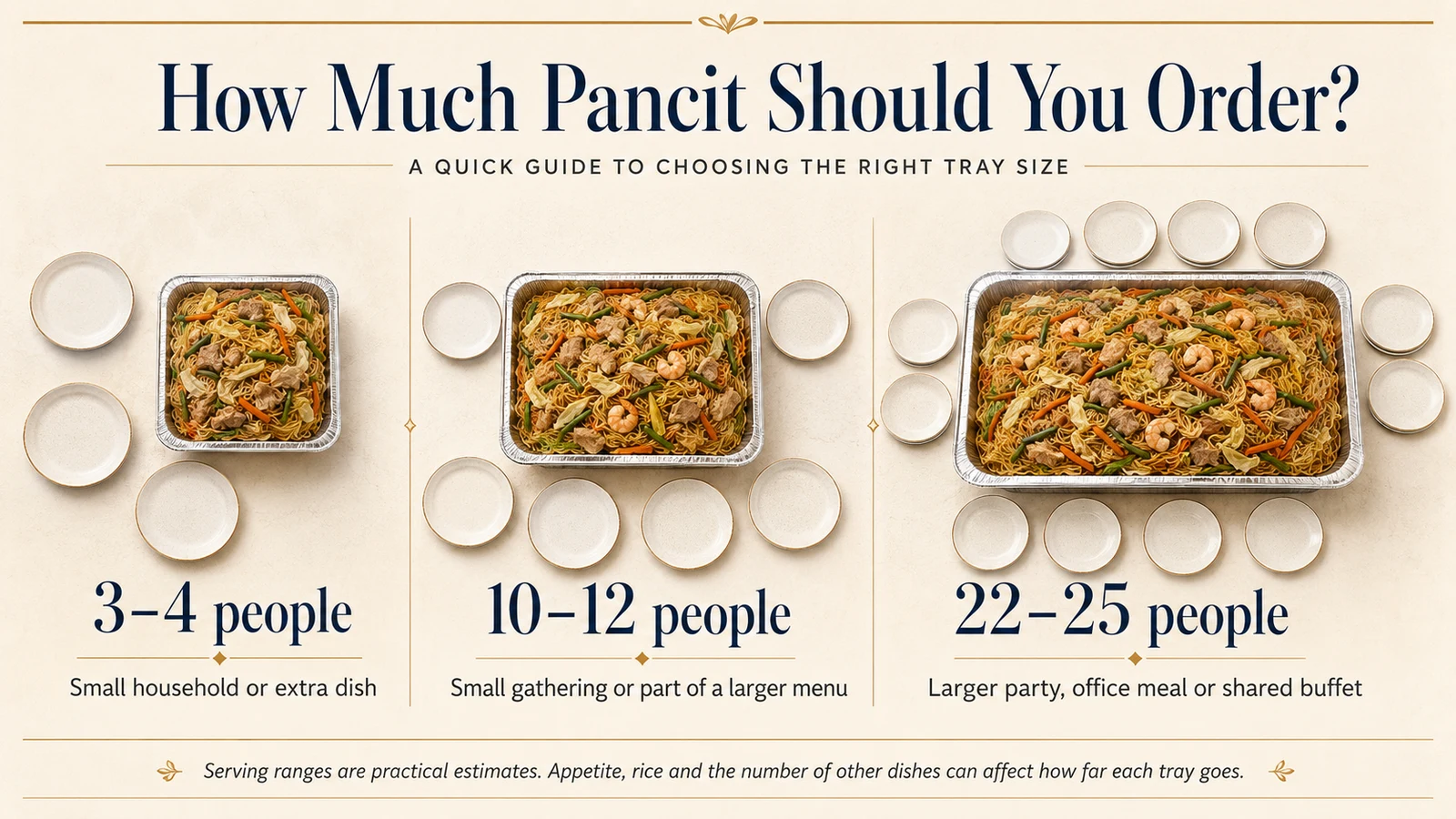
Use the current 3–4, 10–12 and 22–25 pax serving ranges as the base of your estimate. Appetite and the rest of the menu can still affect where within each range your group lands.
pax
Small household, additional dish or a little extra allowance.
pax
Small gathering or one noodle choice within a larger meal.
pax
Larger party, office meal or shared buffet.
Methodology and Review
How the Pancit Quantity Estimate Works
The guide uses Jojie's current 3–4, 10–12 and 22–25 pax serving ranges and reviews the result according to the role pancit plays in the complete meal.
Count expected pancit eaters
Start with the people likely to take noodles rather than assuming the entire attendance needs a full portion.
Choose the menu role
Main food may need a modest allowance; several-dish meals can start with the listed capacity; an additional side may stretch further beside rice and other dishes.
Build a practical combination
The calculator combines only the current 3–4, 10–12 and 22–25 pax tray ranges.
Review the complete spread
Rice, other starches, children, second helpings and the number of viands can change how far the trays go.
Planning note: this is a starting estimate, not a guarantee that every guest will take the same portion.
Estimate in Three Steps
Count Likely Eaters, Define the Noodle’s Role, Then Choose the Trays
Count the guests likely to take pancit
Do not automatically use the full attendance. Consider young children, guests avoiding noodles, another pasta dish, staff and suppliers, and a small allowance for late arrivals or seconds.
The useful number is expected pancit eaters—not simply everyone invited.
Decide what role pancit will play
Main food
Cover the expected eaters and consider a modest allowance.
One of several dishes
Use the listed tray capacity as a practical starting point.
Additional side
Rice and other dishes may reduce each guest’s pancit portion.
Match the estimate with available tray sizes
Choose the tray or combination that covers your expected eaters. When your number falls between combinations, check the menu before automatically choosing the larger amount.
Pancit Party Tray Planner
Starting Tray Combinations by Expected Pancit Eaters
This table shows common starting points using Jojie's current 3–4, 10–12 and 22–25 pax serving ranges. Use the estimator when pancit is the main food or when you want a more conservative allowance.
| Expected pancit eaters | Possible starting point | What to consider |
|---|---|---|
| Up to 4 | One 3–4 pax tray | Within the current small range; use the estimator if pancit is the main food and you want a more conservative allowance. |
| Around 10 | One 10–12 pax tray | A practical starting point when the group is near the lower end of the medium range. |
| Around 20 | One 22–25 pax tray | The large range gives some room above 20; review appetite and the rest of the menu. |
| Around 30 | One 22–25 pax tray plus one 10–12 pax tray | The combined listed range is about 32–37 pax. |
| Around 50 | Two 22–25 pax trays | The combined listed range is about 44–50 pax; use the estimator when pancit is central to the meal. |
| More than 50 | Build a combination from 3–4, 10–12 and 22–25 pax trays | The estimator can use a lower, middle or upper planning point within the verified ranges based on the meal context. |
Worked Examples
How Much Pancit for 10, 20, 30, 50 or More Guests?
Use the examples as starting points, then adjust for the complete menu.
10 guests
One 10–12 pax tray
Main food: 10 is at the lower end of the range, so review whether seconds are likely.
With rice and viands: it is a sensible starting point.
20 guests
One 22–25 pax tray
Full party menu: the large tray range gives a useful allowance beside rice, appetisers and several viands.
Main office merienda: use the conservative estimator setting when generous portions or seconds are likely.
30 guests
One 22–25 pax tray plus one 10–12 pax tray
The combined listed range is about 32–37 pax, giving a practical allowance around a 30-person target.
50 guests
Two 22–25 pax trays
The combined listed range is about 44–50 pax. This may suit a varied menu; use the conservative estimator setting when pancit carries more of the meal.
Larger groups
Build in layers
- Around 60: two 22–25 pax trays plus one 10–12 pax tray give a combined range of about 54–62 pax
- Around 70: three 22–25 pax trays give a combined range of about 66–75 pax
- Around 100: four 22–25 pax trays give a combined range of about 88–100 pax; use the estimator for a more conservative main-food plan
Confirm large orders with Jojie's before finalizing.
Examples by Occasion
How Much Pancit for a Birthday, Office Merienda or Buffet?
Birthday with rice and several viands
Count the guests likely to take pancit, then use the listed capacity as a practical starting point because the noodles are one choice among many. If you still need the other shared dishes, browse Party Trays and Food Trays after estimating the pancit quantity.
Office merienda where pancit is central
Cover the expected pancit eaters and include enough support from appetizers, sandwiches or another filling dish. If individual distribution matters more than shared serving, compare Packed Meals Manila instead.
Children’s party
Count adults and older children closer to regular eaters, allow less for toddlers and remember parents, helpers and suppliers.
Buffet with several starches
Not every guest needs a full pancit serving when rice, pasta or another noodle is also available.
Adjust the Estimate
What Changes How Far a Pancit Tray Goes?
Rice and other starches
Rice usually reduces how much pancit each guest takes because both compete for space on the plate. Another pasta or noodle reduces it further.
Number of viands
Several meat and vegetable dishes encourage smaller noodle portions. A sparse menu places more pressure on the pancit tray.
Children and mixed ages
Appetites vary. Count older children who enjoy pancit closer to regular eaters and use a smaller allowance for very young children.
Second helpings and leftovers
Add a little extra when pancit is a favourite or the event runs for several hours. A smaller tray may be enough; you do not always need another large one.
Noodle Style and Portion Feel
Does the Type of Pancit Change the Quantity?
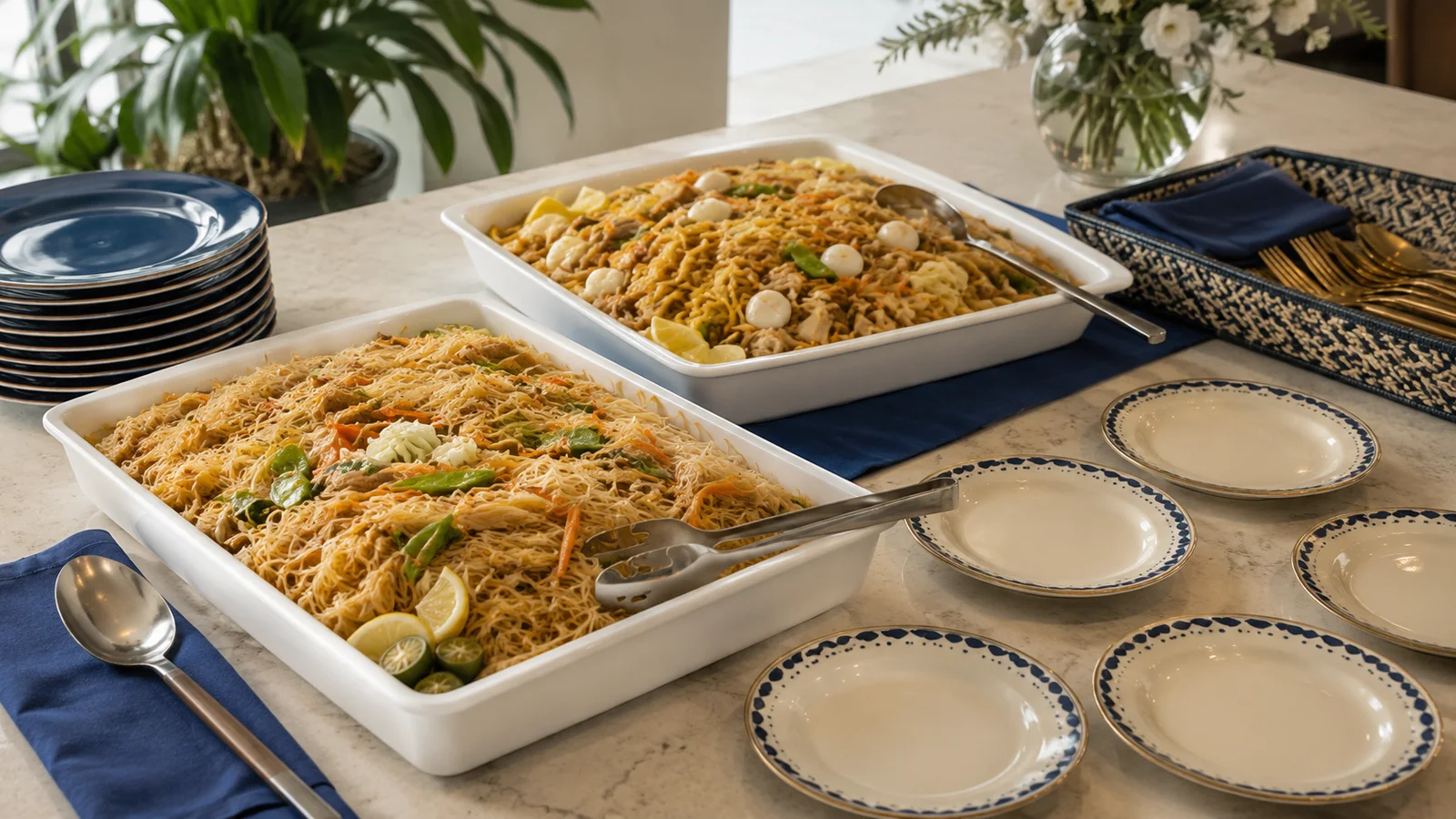
The current tray sizes remain the starting point, but different noodles can feel different on the plate.
- Pancit BihonFine, delicate rice strands that sit lightly beside rice and richer viands.
- Pancit CantonPlump, golden noodles with a firmer, heartier bite.
- SotanghonSilky, translucent glass noodles with a smooth, lightly springy texture.
- Korean Sotanghon (Japchae)Darker, glossy glass noodles and a distinct eating experience.
- Mixed Sotanghon Canton and Miki-BihonContrasting noodle textures in the same tray.
- ChamiThicker, softer and saucier noodles for a richer preparation.
Interactive Planning Tool
Estimate Your Starting Pancit Quantity
Enter the expected number of pancit eaters and tell us what role the noodles will play. The estimator uses Jojie's current 3–4, 10–12 and 22–25 pax serving ranges and adjusts the planning point within each range to match the meal context.
Your starting estimate will appear here.
This is a planning estimate. Appetite, menu variety and serving style can affect how far each tray goes.
Why One Formula Does Not Fit Every Party
Why We Do Not Use a Fixed Grams-Per-Person Rule
A rigid per-person number can look precise while giving the wrong answer for the actual menu.
Plates are built differently
A guest at a full buffet may take only a small forkful of pancit. The same guest may take a much larger portion when noodles are the main merienda.
Guest appetites are not identical
Adults, children, older relatives and enthusiastic noodle eaters create a wider range than one standard serving can represent.
Other starches compete for space
Rice, pasta, bread and another noodle dish reduce the amount of pancit most guests can comfortably fit on the plate.
Serving style changes behaviour
A self-service buffet, pre-portioned meal and shared family table encourage different serving sizes and different rates of second helpings.
Use the listed tray capacity as the dependable base: then add a modest allowance when pancit is central to the meal or second helpings are likely.
Serving Style
How the Way You Serve Pancit Changes the Estimate
Shared buffet
Guests choose their own portions
Some guests will skip pancit, while others may return for seconds. Menu variety becomes the most important adjustment.
Family-style table
Trays are passed and shared
Portions may become more even, but guests seated nearest the tray can serve first. Place serving utensils and enough table space around the noodles.
Office distribution
A short break can concentrate demand
When everyone eats at the same time, choose a combination that is easy to open, place and serve without creating one crowded queue.
Pancit as take-home extra
Leftovers may be acceptable
When the host is comfortable keeping a modest amount of extra food, choose the more comfortable tray combination rather than the tightest mathematical fit.
Quantity Guide FAQ
Common Pancit Serving and Party-Tray Questions
How much pancit should I order per person?
Use Jojie's 3–4, 10–12 and 22–25 pax serving ranges rather than a fixed grams-per-person rule. Match the range to the expected pancit eaters and use a more conservative planning point when pancit is the main food.
How much pancit do I need for 20 people?
One 22–25 pax tray is a practical starting point for 20 people. Review whether pancit is the main food and whether second helpings are likely.
How much pancit do I need for 50 people?
Two 22–25 pax trays provide a combined listed range of about 44–50 people. When pancit is central to the meal, the estimator uses a more conservative planning point and may recommend an additional tray.
Should I count every guest for pancit?
Not always. Estimate likely pancit eaters and account for rice, other starches, children and the number of filling dishes.
How many people does 1 kilo of pancit serve?
Jojie's does not use a fixed kilo-to-guest conversion on the current Pancit menu. The current choices are planned using the listed 3–4, 10–12 and 22–25 pax tray ranges, and the amount people take still changes with the noodle, the rest of the menu and whether pancit is the main food. Use the current tray capacities rather than assuming one kilo always serves the same number of people.
Where can I check the current pancit tray price?
Use the dedicated Pancit page for current tray prices, noodle choices, serving sizes and ordering details.
Before You Order
Check the Menu and Final Details
Confirm how many guests are likely to take pancit, whether rice is served, how many other filling dishes are available and whether modest leftovers are acceptable.
Use the dedicated Pancit page for current choices, tray sizes, prices and ordering information.
Prepare these details
- Event date and eating time
- Expected pancit eaters
- Preferred noodle choice
- Other starches and viands
- Pickup or courier details