


A practical reunion guide for committees and family organizers
Homecoming and Reunion Planning Guide
A reunion is easier to organize when the work does not live in one person’s head.

Whether you are planning a class or batch reunion, school homecoming or a large family gathering, begin by deciding who owns each part of the plan. Then work through attendance, venue and travel, food, program and day-of responsibilities in an order that keeps everyone working from the same information.
The goal is not to make the reunion elaborate. It is to make it easy for people to attend, reconnect and enjoy the gathering.
Homecoming vs reunion: what’s the difference?
The words are often used together, but they do not always describe exactly the same gathering.
A reunion usually brings a defined group back together. That could be a graduating class, school batch, former colleagues, clan or extended family.
A homecoming usually places more emphasis on returning to a school, organization, hometown or community connected with the group’s shared history. A school homecoming may include several batches or alumni groups rather than only one graduating class.
In practice, the planning work overlaps: you still need a clear organizing team, attendee list, venue, budget, food, communications and program.
If the gathering is being organized formally under a school or alumni association, confirm that organization’s current rules before using its name, facilities, branding or official homecoming designation. Individual institutions may have their own approval process.
For an informal class or batch gathering, the committee can usually focus directly on what will make it easy for people to reconnect.
Give every major task an owner
A reunion committee does not need to be large. It does need clear responsibilities.
A practical division may look like this:
- Overall coordinator
- Decisions, deadlines and unresolved issues
- Attendance
- Guest list, RSVPs and contact updates
- Budget
- Working budget, payments and records
- Venue and logistics
- Location, access, parking and setup
- Food
- Meal format, caterer coordination and dietary information
- Program
- Welcome, activities, memories, speakers and timing
- Communications
- Invitations, reminders and final instructions
- Day-of coordination
- Supplier arrivals, guest questions and schedule changes
One person can own more than one area. What matters is that nobody assumes somebody else is handling it.

Build one useful attendee list
Old reunion lists often become a collection of names spread across chat groups, spreadsheets and social-media threads.
Instead, keep one working list.
For each invited person or household, record only the information you genuinely need, such as:
- Name or household
- Class, batch or family branch where relevant
- Best contact method
- Likely number attending
- Confirmed number attending
- Travel or access information they have asked you to consider
- Dietary information they have chosen to share
For a large family reunion, household-level responses may be easier to manage than chasing every relative individually.
For a class or batch reunion, old yearbooks and graduation records can help identify people, while current contact information should come from the person or a reliable current connection.
Do not publish private contact lists inside public reunion groups.
Make the RSVP easy to answer
People are more likely to respond when the request is simple.
Ask for the information you actually need to plan:
- Will you attend?
- How many people are coming with you?
- Do you need arrival, accessibility or seating information clarified?
- Is there dietary information the food team should know?
- Are you travelling from outside Metro Manila or from farther away?
Keep the response method consistent. If confirmations arrive through several channels, assign somebody to move them into the same master list.
The important number is not how many people were invited. It is the working number the venue, food team and organizers are actually using.
Make the reunion welcoming to people who are unsure about attending
Not everybody approaches a reunion with the same excitement.
Some people have stayed close to their classmates. Others have not spoken for years. Some may be returning from overseas or another province. Some may feel uncomfortable about career comparisons, personal questions or walking into a room where everyone appears to have an established circle.
The committee cannot control every conversation, but it can make the gathering easier to enter.
- Give guests a clear arrival point and someone who can welcome people who arrive alone.
- Use name tags where they genuinely help.
- Avoid making every guest give a public life or career update.
- Do not make games, performances or sharing activities compulsory.
- Give people unstructured time to talk.
- If the group is large, create natural ways for people from different circles to reconnect without forcing them into embarrassing icebreakers.
- When collecting old photos or personal updates, ask before displaying information that somebody may not expect to be shown publicly.
A successful reunion does not require everyone to prove what they have achieved since graduation. The reason people came is enough: they chose to reconnect.
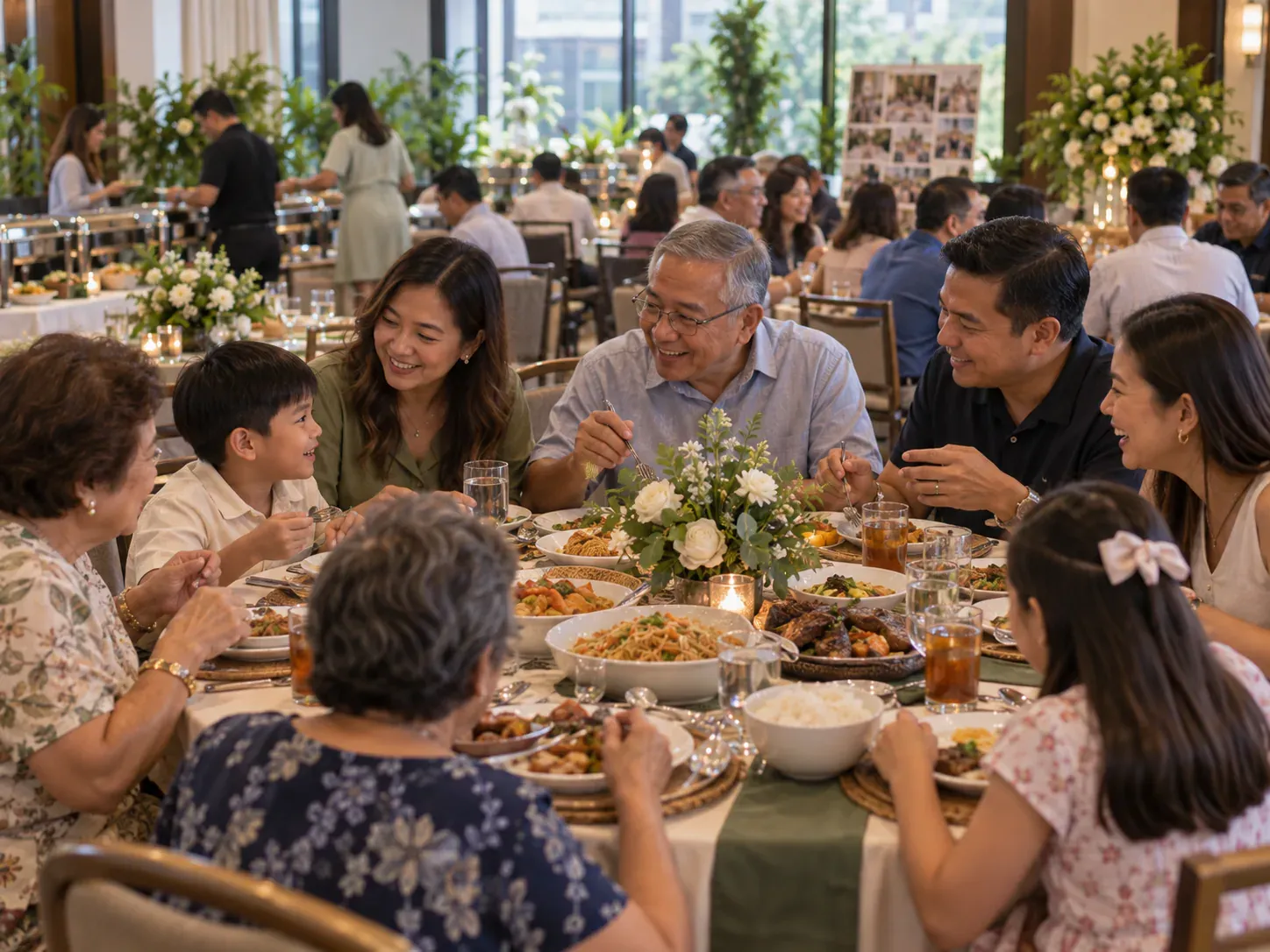
Choose the venue for the people attending
A reunion venue should support conversation and comfort before it supports the photo backdrop.
Check the actual guest mix.
For a class or batch reunion, people may want room to move around and reconnect rather than stay at one table for the entire program.
For a multigenerational family reunion, consider older relatives, young children and guests who may need shorter walking routes or more comfortable seating.
Before confirming a venue, check practical details such as:
- usable capacity and seating;
- stairs, lifts and accessible routes;
- restrooms;
- parking and drop-off;
- public-transport access where relevant;
- indoor or weather-backup space;
- food and outside-caterer rules;
- supplier entry and loading;
- setup and pull-out times;
- sound or program restrictions.
In Metro Manila, also look at the actual travel route and likely traffic pattern rather than judging distance only by kilometres.
Ask about food and supplier rules before paying for the venue
A venue can look suitable and still create problems for the committee if its supplier rules do not match your plan.
Before paying a deposit, ask:
- Can an outside caterer enter the venue?
- Is outside food permitted?
- Is there corkage or another supplier charge?
- Are tables and chairs already included?
- Where can food and equipment be unloaded?
- What time can suppliers enter?
- Is there a service lift or separate supplier entrance where relevant?
- When must setup and pull-out finish?
Get the answers that affect your reunion in writing where practical.
Think about people travelling to the reunion
Some guests may be coming from another part of Metro Manila. Others may be travelling from another province or returning to the Philippines for the gathering.
Your committee does not need to become a travel agency.
It does help to share reliable practical information: complete venue address, landmark or entrance instructions, parking details, expected start and finish, and any hotel or accommodation information the committee has independently verified.
If several guests are arriving from far away, avoid making the most important part of the program dependent on everyone arriving at the exact same minute.
Metro Manila reunion logistics to settle before invitations go out
For a local reunion, the venue choice should work for the people attending, not only for the committee. Check the likely travel routes, parking or drop-off, lift access, toilets, air-conditioning or ventilation, and how far older relatives or guests with mobility needs must walk.
For the food and event suppliers, confirm the loading area, building or village access rules, setup window, power restrictions, buffet location, cleanup or pull-out time and the venue contact who can authorize access. These details are especially useful when the program has a fixed meal time.
Jojie's is based in Manila and serves events across Metro Manila, subject to the date, location, travel, venue access, staffing, equipment and confirmed requirements.
Decide how the reunion will be funded
Do not let one or two organizers quietly carry an unclear financial obligation.
Agree on the budget approach before committing to major expenses.
Depending on the group, the reunion may be funded through attendee contributions, an existing organization or alumni fund, voluntary sponsorship, or another arrangement the group agrees on.
Keep the numbers visible to the people responsible for decisions.
Separate confirmed funds from hoped-for contributions.
If somebody volunteers to sponsor part of the event, confirm exactly what that sponsorship covers rather than building the plan around an assumption.
Plan food around the actual gathering
Food is often one of the main shared experiences at a reunion, but the right setup depends on the event.
Start with:
- Headcount
- Use the latest realistic number.
- Schedule
- When will people arrive, and when does the main program happen?
- Venue
- What food setup does the space allow?
- Guest mix
- Are children, older relatives or travelling guests part of the group?
- Service format
- Does the gathering need full-service catering, a simpler meal setup or another approach?
- Dietary information
- Collect information guests want the food team to know and communicate it clearly to the relevant provider.
Do not assume that a reunion automatically needs several meals or a full-day catering arrangement.
Choose the service level, not just the menu
A delivered food-only arrangement can suit a smaller reunion when the committee or venue will handle receiving, tables, serving and cleanup. A staffed buffet or broader catering scope is more useful when the group wants food service, buffet setup, equipment or event support coordinated with the program.
For larger gatherings where the committee wants those responsibilities handled as a defined catering scope, see full-service catering and setup. Ask for a written quotation based on the actual headcount, venue, meal time, access and service requirements rather than assuming a fixed reunion package or per-head rate.
Request a reunion catering quotation when the working date, venue and guest-count range are ready.
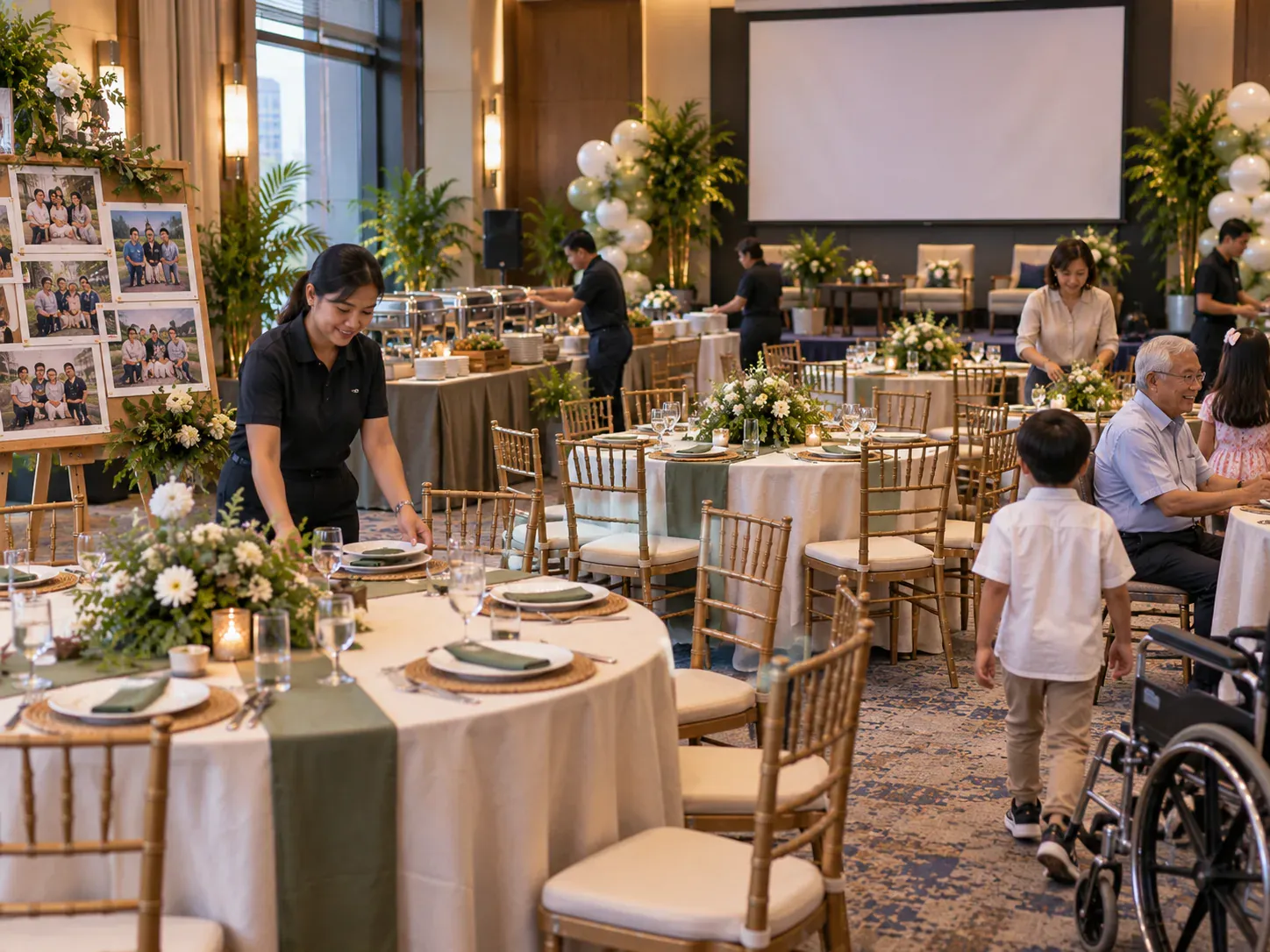

Give the program a reason to exist
A reunion program should help people reconnect. It should not prevent them from talking to one another.
Start with a few anchors.
A class or batch reunion might include a welcome, recognition of classmates or teachers, old photographs, a short memory segment, updates from the group and a class photo.
A family reunion might include introductions across generations, family-history material, photographs, recognition of elders, activities for children or a short remembrance of relatives who are no longer present.
None of these is compulsory.
Choose what has meaning for your group.
Leave enough unscheduled time for people to sit together, catch up and move between conversations.
A simple reunion program you can adapt
There is no required reunion program, but having a few anchors can keep the event from becoming either over-programmed or directionless.
A simple class, batch or family reunion might flow like this:
- 0:00–0:30 · Arrival and free conversation
- Registration, name tags if useful, informal photos and enough time for people to find friends before the formal program begins.
- 0:30–0:40 · Short welcome
- Explain why the group has gathered, acknowledge organizers and share only the practical information guests need.
- 0:40–1:20 · Meal and conversation
- Serve the main meal while people still have time and energy to talk. Avoid putting speeches over the entire eating period.
- 1:20–1:45 · Memories or recognition
- Old photographs, teachers, family history, classmates or relatives worth remembering, depending on the group.
- 1:45–2:05 · One optional activity
- Use one game, update or presentation that helps people reconnect rather than filling time for its own sake.
- 2:05–2:20 · Group photograph
- Take the full-group photo while most people are still present, then any batch, family-branch or table photos that matter.
- 2:20–2:50 · Free conversation
- Leave a real unscheduled block for catching up, exchanging contact details and visiting different tables.
- 2:50–3:00 · Short closing
- Thank the group and explain where photos or future reunion updates will be shared.
The exact order can change.
For many reunions, a shorter formal program with more time for conversation will work better than filling every available minute.
Remember people without making the reunion heavy
For long-running class, batch and family reunions, some people who were once part of the group may no longer be there.
If it fits the group, a short remembrance can acknowledge classmates, teachers, relatives or friends who have passed away.
Keep it respectful and proportional to the gathering.
This could be as simple as a photograph, a slide, a list of names or a brief moment in the program.
Confirm names and details before displaying them, and be sensitive about photographs or personal information supplied by families.
The purpose is remembrance, not turning the reunion into a memorial service unless that is what the group intentionally wants.
Make family and class history easy to contribute
Reunions are one of the few occasions when stories, photographs and people from different periods may be together in one place.
If history matters to the gathering, assign someone to coordinate it before the event.
You might ask guests to contribute old class photographs, yearbook images, reunion photos, family photographs or short memories.
Decide how these will be displayed or collected and who will look after original items.
For family reunions, identify people in photographs while relatives who know the stories are available to help.
Do not make participation compulsory. Some guests will simply want to attend and reconnect.
Plan for different generations and energy levels
A program that works for former classmates of similar age may not work for a family reunion that includes small children, parents, grandparents and older relatives.
Provide comfortable places to sit and talk.
Keep high-energy activities separate from quieter conversation areas where possible.
If games are included, make participation optional.
Avoid making older guests, children or people with mobility needs travel repeatedly across a large venue just to follow the program.
A reunion should feel welcoming even to someone who does not want to join every activity.
Prepare one day-of information sheet
The committee should not be searching through months of chat messages during the event.
Keep one current day-of sheet containing:
- Venue
- Address, entrance and venue contact
- Schedule
- Main program times
- Attendance
- Latest confirmed headcount
- Food
- Caterer or food contact and service time
- Setup
- Access and supplier arrival times
- Committee
- Names and phone numbers of key organizers
- Program
- Who owns each major segment
- Payments
- Only unresolved event-day items
- Contingency
- Who decides if timing, weather or attendance changes
Give the relevant parts to the people who actually need them.
The organizer should not have to answer every question personally.
Have a contingency plan for the things that matter
You do not need a backup plan for every small detail.
Focus on changes that can disrupt the whole gathering.
What happens if the expected headcount changes significantly?
What happens if weather affects an outdoor setup?
Who decides if the program starts late?
Who contacts the venue or caterer if access changes?
How will guests receive an urgent update?
When responsibilities are already assigned, these decisions become much easier.
For a clan or large family reunion
Family reunions often add a layer that class reunions do not have: several generations, different household sizes, family branches, children and relatives travelling from different places.
Use the same core system, but pay particular attention to:
- Household headcount
- Older relatives and accessibility
- Children and activity space
- Travel and arrival information
- Family-history or photo material
- How costs are shared
- Who represents each family branch for updates
The aim is not to create a complicated family hierarchy. It is simply to make communication manageable.
When should you start planning a reunion?
Start when the core group has agreed that the reunion will actually happen.
There is no single correct number of months for every reunion.
Instead, identify the hardest constraint.
If many guests need to travel, the date may need attention early.
If there are only a few suitable venues, venue availability may drive the schedule.
If the group is large and contact information is badly outdated, rebuilding the attendee list may take more work than expected.
If the reunion is an official school or alumni-association homecoming, the institution’s own schedule and approval process may control the timeline.
Work backward from those constraints.
A small local batch dinner and a large homecoming involving several graduating classes should not be given the same planning timetable.
In the final planning stage
Stop adding new ideas and confirm the decisions people already depend on.
Recheck the latest headcount, venue arrangements, program, food schedule, supplier access, committee responsibilities and guest instructions.
Send attendees the information they need to arrive without asking the committee the same questions individually: date, time, complete address, entrance or parking guidance and any useful arrival instructions.
Then make sure every committee member knows what they own on the day.
After the reunion
Do not let the planning system disappear as soon as the last guest leaves.
Close the event properly.
- Settle outstanding venue, supplier or committee expenses.
- Return borrowed or rented items.
- Save invoices and payment records where the committee needs them.
- Share photographs through the channel the group agreed to use.
- Update the attendee/contact record only with information people have chosen to provide.
- Send thank-you messages where appropriate.
- Record what worked and what should change next time.
If another reunion is likely, identify who will keep the records so the next organizing committee does not have to rebuild everything from zero.
For an official alumni or organizational homecoming, follow that institution’s own closeout and documentation requirements.
The short version
A practical reunion plan follows this order:
purpose → planning team → attendee list → working headcount → date and venue → budget → travel and accessibility → food → program and history → final confirmations → day-of responsibilities.
If something changes, update the parts that depend on it instead of reopening every decision.
FAQ
What is the difference between a homecoming and a reunion?
A reunion normally brings a defined group such as a class, batch or family back together. A homecoming usually adds the idea of returning to a school, organization or community and may involve several groups or graduating classes. The terms can overlap, so use the name that makes sense for your group and confirm any official institutional rules.
What does alumni homecoming mean?
An alumni homecoming is a gathering built around returning to a school or alumni community. It may include several graduating classes or batches and can be organized under an institution or alumni association. If it is an official event, follow that organization’s current approval, venue and branding rules.
What is a simple batch reunion program?
A practical three-hour flow can leave the first 30 minutes for arrival, use a short welcome, serve the meal early, reserve one focused block for memories or recognition, include one optional activity, take the group photograph, then leave the remaining time for conversation before a brief closing.
How do you organize a class or batch reunion?
Start with a small organizing team, build one attendee list, estimate the working headcount, agree on the budget approach, choose the date and venue, then work through food, communications, program and day-of responsibilities. Assign an owner to every major task.
What should a reunion program include?
Only what helps the group reconnect. A welcome, shared meal, photographs or memories, one or two meaningful activities, a group photo and plenty of conversation may be enough. Avoid filling the schedule simply because time is available.
How do you plan a family reunion for children and older relatives?
Choose the venue and program around the complete age mix. Consider walking distance, seating, toilets, accessibility, children’s activity space, meal timing and quieter places where people can talk comfortably.
How far ahead should we plan a reunion?
There is no universal timetable. Start with the hardest constraint—guest travel, venue availability, the size of the contact list or an institution’s homecoming schedule—and work backward from it.
When is catering useful for a reunion?
It can be useful when the committee wants a defined provider to handle an agreed food and service scope rather than organizing those details individually. The appropriate arrangement depends on headcount, venue, schedule and service needs. Ask for a written quotation based on the actual reunion.