



What Is a Filipino Fiesta?
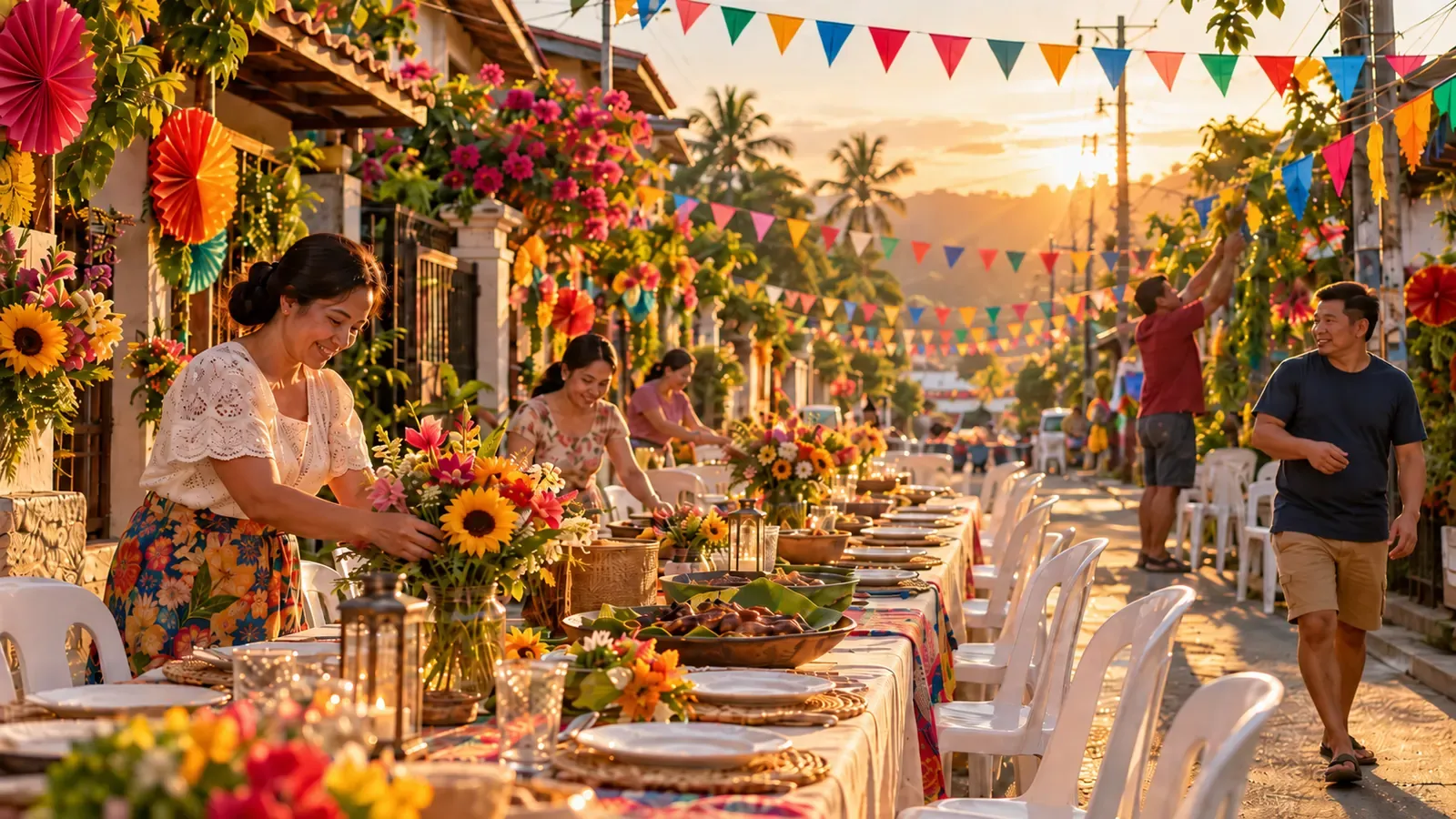
In the Philippines, a fiesta is an annual or recurring celebration connected to a particular place, community, religious devotion or local tradition.
Many familiar town fiestas developed around Catholic patronal feast days during the Spanish colonial period. Processions, novenas, music, decorated streets and public gatherings became part of the celebration in many places. Philippine communities also had ceremonial and communal feasting before Spanish rule, so the wider story of celebration in the country is older and more layered than one origin.
Modern practice varies widely. A Fiesta may involve a parish programme, a procession, street activity, music, games, visiting relatives, a household handaan or some combination of these. In another place, the public programme may be large while a particular family celebrates quietly at home.
Different communities may observe the occasion in different ways. For a host, what matters is what the celebration means locally and which parts the household is expected to take care of.
Fiesta, Pista, Piyesta, Kapistahan and Handaan
These words can overlap in everyday conversation, but they do not always describe exactly the same thing.
Fiesta comes from Spanish and remains widely used in the Philippines. Pista and piyesta are familiar Filipino forms of the word. Kapistahan can refer to a feast or celebration, particularly in a community or religious context.
Handaan usually points more directly to the food and gathering prepared for guests.
That distinction matters when you are planning. The wider Fiesta may belong to the town, barangay, parish or community, while your household’s handaan is the part you control: the guest list, food, serving area, seating and workload.
People may use the terms more loosely in ordinary speech, so the local context still matters more than a rigid definition.
Why Communities Celebrate
There is no single reason behind every Filipino fiesta.
Faith and patronal tradition
Many town and parish fiestas honour a patron saint or religious devotion. In these settings, Masses, novenas, processions and other devotional activities may form an important part of the schedule.
Harvest and thanksgiving
Some celebrations are closely connected to agriculture, harvest or thanksgiving. Local produce, decoration, food and community participation may become part of the identity of the occasion.
Place and local identity
An annual Fiesta can also be a marker of belonging. It may be the time when a town or neighbourhood becomes especially active and when people who now live elsewhere make an effort to return.
Civic and cultural celebration
Modern local celebrations may also include civic anniversaries, competitions, performances, street activities or tourism programmes.
These categories can overlap. A celebration may remain religiously important while also becoming a civic event, a cultural showcase or a reason for families to come home.
Where Fiesta Traditions Come From
The history of the Filipino Fiesta is layered.
Archaeological and historical research supports the existence of ceremonial and community feasting in Philippine societies before Spanish rule. These earlier gatherings should not be treated as identical to the modern town fiesta, but they show that shared feasting and ritual celebration were already part of local life.
During the Spanish colonial period, Catholic feast-day traditions became closely tied to pueblo and parish life. Missionaries used processions, music, public ceremony and spectacle as part of Christian religious practice. Patronal celebrations, novenas, vísperas, processions and local sponsorship became familiar features in many towns.
Filipino communities did not simply reproduce one fixed model. Practices were adapted locally, combined with existing customs and changed over time.
That is why familiar Fiesta traditions can look very different from one province, town or household to another.
Why There Is No Single Fiesta Formula
A Fiesta can have several layers happening at the same time.
The community may have a public programme. A parish may have a devotional schedule. Streets or public spaces may have music, decorations or activities. Individual households may decide separately whether they will cook for relatives, receive visitors or hold a smaller handaan.
The town’s Fiesta and your family’s food plan are connected, but the household still has its own guest, food and hosting decisions to make.
The same is true of the atmosphere. In some places, religious devotion remains central. In others, civic activities, entertainment and tourism are highly visible as well. Some households prepare for many visitors. Others celebrate mainly with close relatives.
Local practice should lead, so before copying a generic Fiesta checklist, confirm what actually matters to the family, community, parish, venue or organisation involved.
Fiestas and Festivals Across the Philippines
One reason there is no single Filipino Fiesta formula is that celebrations across the country grew from different local histories, devotions, harvests and community traditions.
The examples below are only a small cross-section. They are not a complete national calendar.
They are also not all the same kind of event. Some are patronal or devotional feasts. Others are harvest, civic, historical, cultural or indigenous festivals. Many combine several layers at once. That difference matters when you compare dates, traditions and what people actually do.
| Celebration | Typical timing | Where | What or why it celebrates |
|---|---|---|---|
| Feast of the Black Nazarene | January 9 | Quiapo, Manila | A major devotional feast centred on the image of the Black Nazarene. |
| Sinulog Festival | January; major activities build toward the third Sunday | Cebu City | Devotion to the Señor Santo Niño expressed through religious and cultural activities. |
| Ati-Atihan Festival | Third Sunday of January | Kalibo, Aklan | A Santo Niño celebration shaped by Aklan’s own local festival tradition. |
| Dinagyang Festival | Late January; annual programme varies | Iloilo | A Santo Niño feast combined with Iloilo’s distinctive performance and cultural festival tradition. |
| Panagbenga Festival | February to early March; annual programme varies | Baguio City | A month-long flower and cultural-heritage celebration associated with Baguio’s blooming season. |
| Moriones | Holy Week | Marinduque | A Holy Week tradition known for Roman-centurion costumes and the story of Longinus. |
| Pahiyas Festival | May 15 | Lucban, Quezon | A harvest thanksgiving honouring San Isidro Labrador, with homes decorated using produce and colourful kiping. |
| Pintados-Kasadyaan Festival | June 29 | Leyte | A celebration connected with the Santo Niño and Leyte’s cultural memory, including references to Visayan tattoo traditions. |
| Sandugo Festival | July; annual programme varies | Bohol | Commemorates the blood compact associated with Datu Sikatuna and Miguel López de Legazpi. |
| Kadayawan sa Dabaw | August; annual programme varies | Davao City | A thanksgiving celebration that also honours the city’s indigenous peoples and cultural communities. |
| Peñafrancia Fiesta | September; annual programme varies | Naga City, Camarines Sur | Honours Our Lady of Peñafrancia, with the fluvial procession among its best-known devotional traditions. |
| Zamboanga Hermosa / Fiesta Pilar | October; feast day October 12 | Zamboanga City | Honours Our Lady of the Pillar, the city’s patroness. |
| MassKara Festival | October; annual programme varies | Bacolod City | A civic festival recognised for masked street celebrations and Bacolod’s public festival culture. |
| Lanzones Festival | October; annual programme varies | Camiguin | A thanksgiving celebration for the island’s lanzones harvest. |
| Higantes Festival / Feast of San Clemente | November 22–23 | Angono, Rizal | Honours San Clemente and is known for giant papier-mâché figures in the town procession. |
| Giant Lantern Festival | December; competition and display dates vary | San Fernando, Pampanga | A Christmas-season celebration showcasing the city’s large, elaborate lantern-making tradition. |
| Kaamulan Festival | Annual programme dates vary | Malaybalay, Bukidnon | Celebrates the cultures and traditions of Bukidnon’s seven indigenous groups. |
Some celebrations have fixed dates. Others follow a recurring Sunday, Holy Week or an annually announced programme. For travel or event planning, check the current schedule with the local government, parish or official organiser because programme dates can change.
What Kind of Fiesta Are You Hosting?
The way people will gather shapes the food and setup before any dish list does.
A family fiesta at home
This works when the celebration is centred on relatives, close friends and a familiar home setting.
At home, the main things to settle are:
- how many people can sit or eat comfortably;
- where food can be received and arranged;
- whether guests will arrive at one time or in waves;
- who will replenish dishes and drinks;
- how leftovers will be stored;
- parking, building access or street access.
A home gathering does not need a very large menu to feel festive. Familiar food served well can be enough.
A neighbourhood or community gathering
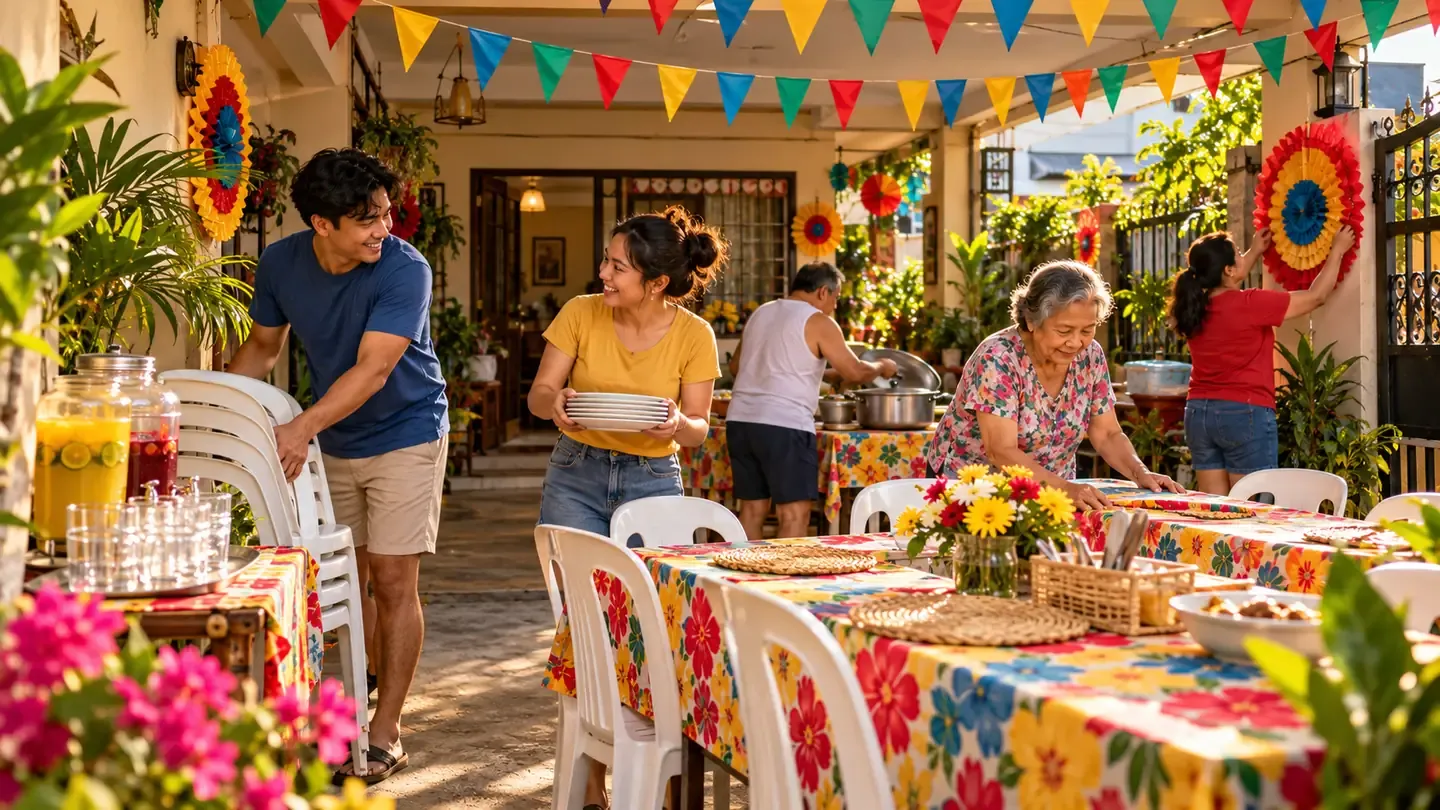
A larger community-style celebration may have more movement, more varied arrival times and more people using the food area.
The setup needs:
- clear buffet flow;
- separate drinks and dessert areas;
- enough serving utensils;
- a covered, stable place for the food;
- tables that do not block walkways;
- a plan for replenishment and clearing.
If the venue is partly outdoors, prepare for heat, rain and wind before guests arrive.
A parish, cultural or local celebration
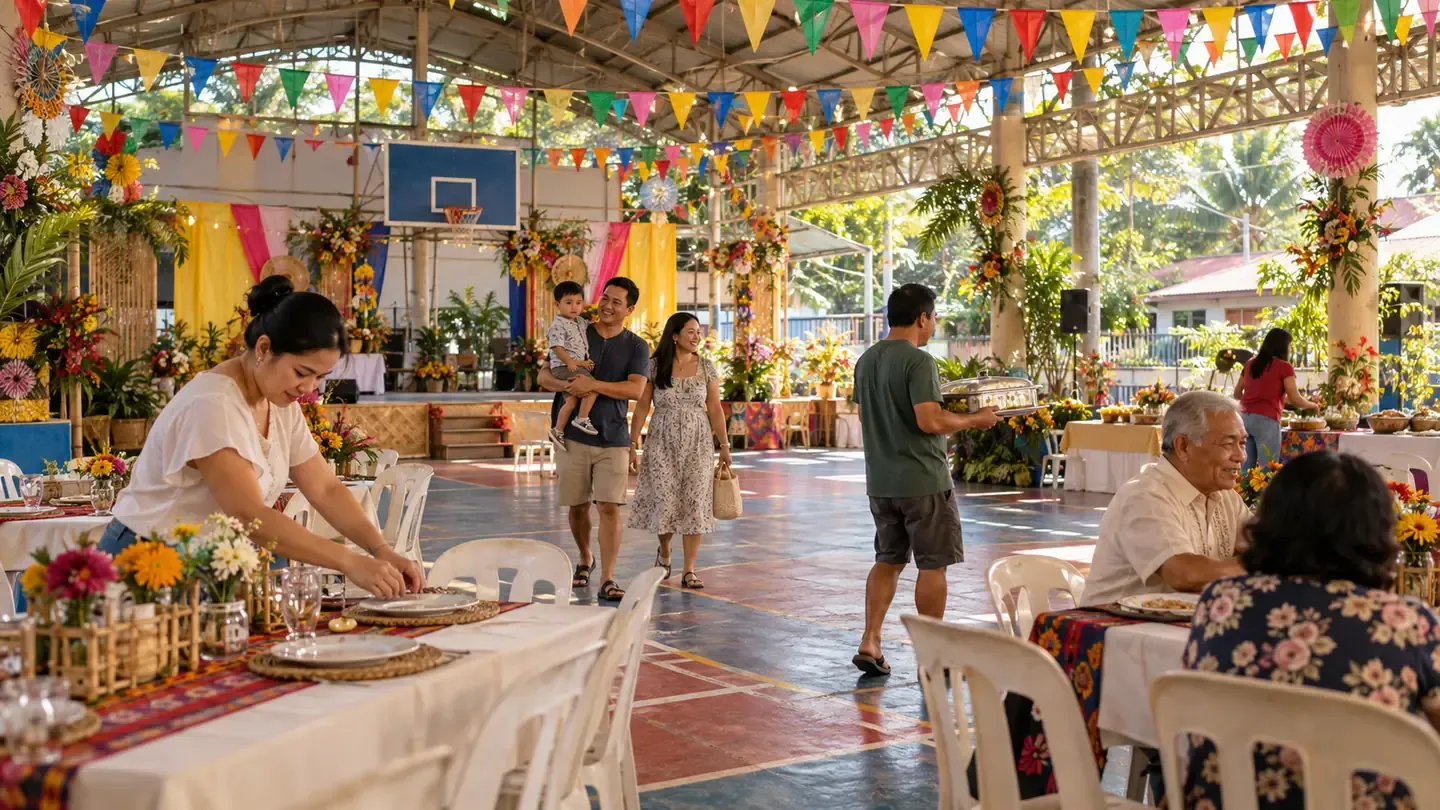
Some fiestas are connected to parish, civic, school, association or local traditions.
The exact customs and rules can vary.
Confirm the venue’s schedule, access, sound, setup and food rules directly instead of assuming that one town or parish follows the same pattern as another.
An office or organisation celebration
A Filipino-themed office gathering usually needs a more controlled schedule.
The meal should be easy to receive, serve and clear within the available break or event window.
For an office or company celebration, see Corporate Catering when you need a more structured meal and service plan.
Food and Hospitality in a Filipino Fiesta
Food is one of the most visible parts of many Filipino celebrations, but it is not the whole Fiesta.
The meal is often part of a wider act of receiving people: relatives, neighbours, friends, community members or invited guests. In some places, households expect visitors throughout the day. In others, the gathering is smaller and more controlled.
Do not assume that every Fiesta is an open house or that every family is expected to feed anyone who arrives.
For the host, hospitality is more practical than that. Guests need a place to sit or stand comfortably, drinking water that is easy to reach, food that can be served safely and a clear idea of who is looking after the table while everyone else is socialising.
A generous table is easier to enjoy when the host is not overwhelmed by it.
When guest boundaries are more open
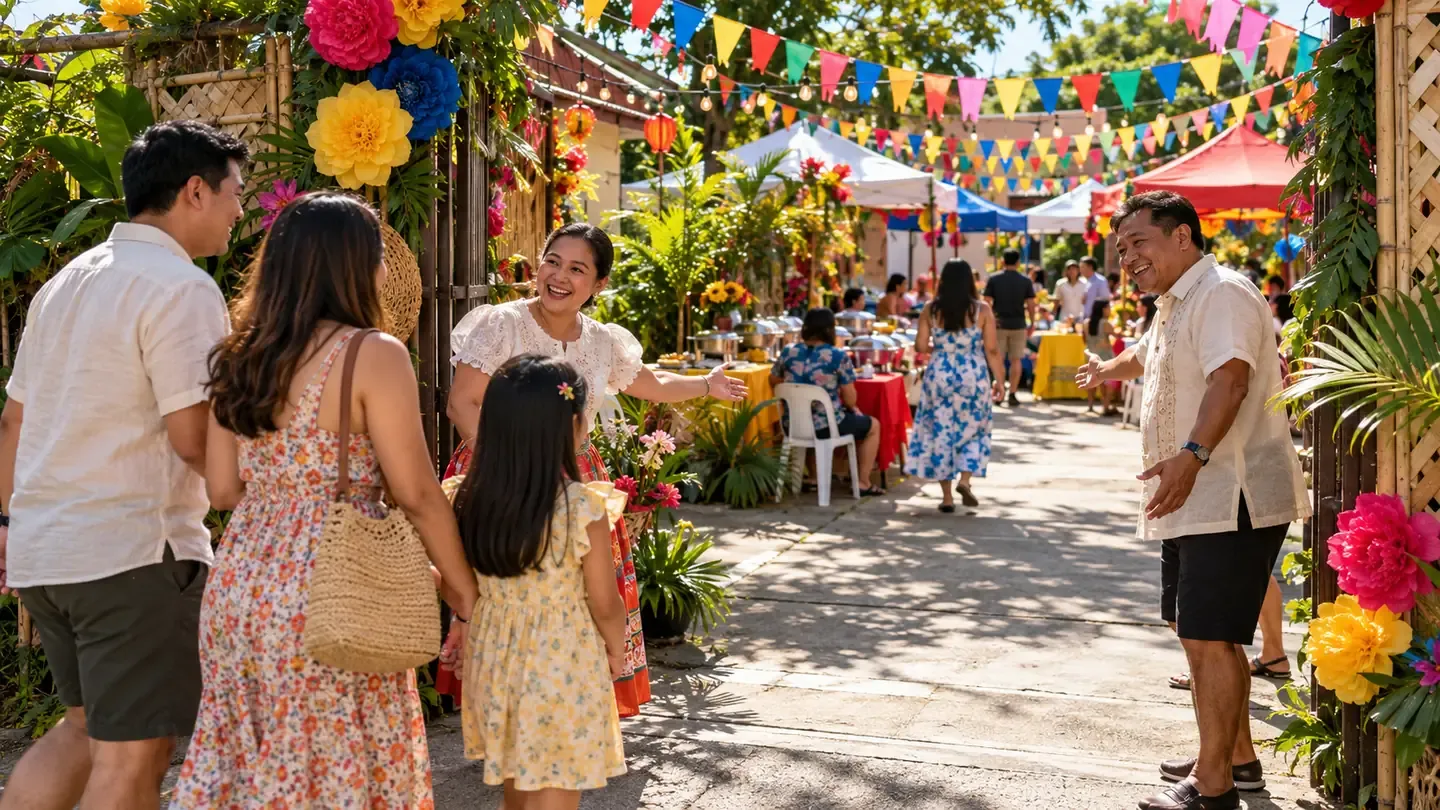
In some communities, especially during a hometown or barangay Fiesta, visiting can be more fluid than it would be at an ordinary private party. Relatives may bring someone with them, neighbours may drop by, and a household may expect people across a long part of the day. In other families, the handaan is clearly invitation-based and the host plans only for people they know are coming.
There is no single rule for every Fiesta household. If you are a guest, ask rather than assuming. If you are hosting, decide how open the household wants the gathering to be and make that expectation clear to relatives who may invite other people.
How the Fiesta Table Works Together
A fiesta table usually works best when the dishes contribute different things to the meal.
Not every gathering needs every category below.
Rice or noodles
Rice or noodles should work comfortably with the rest of the meal.
Rice is practical with saucy dishes and heavier mains. Pancit can add variety and is familiar at many Filipino celebrations.
If you serve both, make sure the rest of the menu still has enough contrast.
One or two main dishes
The main dishes should feel different from each other.
For example, two rich pork dishes may feel repetitive even if both are popular. A better spread may combine a richer main with chicken, fish or another contrasting dish.
Finger food or a shared starter
Lumpia, barbecue, bite-sized food or another easy-to-share option can help while guests are arriving.
These work especially well when people are socialising before the main meal.
A vegetable or lighter supporting dish
A fiesta table can become heavy quickly.
A vegetable dish or fresher-tasting side adds contrast when the rest of the table is rich or heavy.
Dessert or kakanin
Cake, kakanin, fruit or another dessert can create a separate ending to the meal.
If dessert needs refrigeration or careful handling, plan where it will stay before serving.
Drinks
Water should be easy to reach.
For larger gatherings, separating drinks from the main buffet can reduce congestion around the food.
Familiar Fiesta Foods Can Be Inspiration, Not a Rule
Certain dishes appear often in Filipino celebrations, but no single dish is required for a Fiesta to feel Filipino.

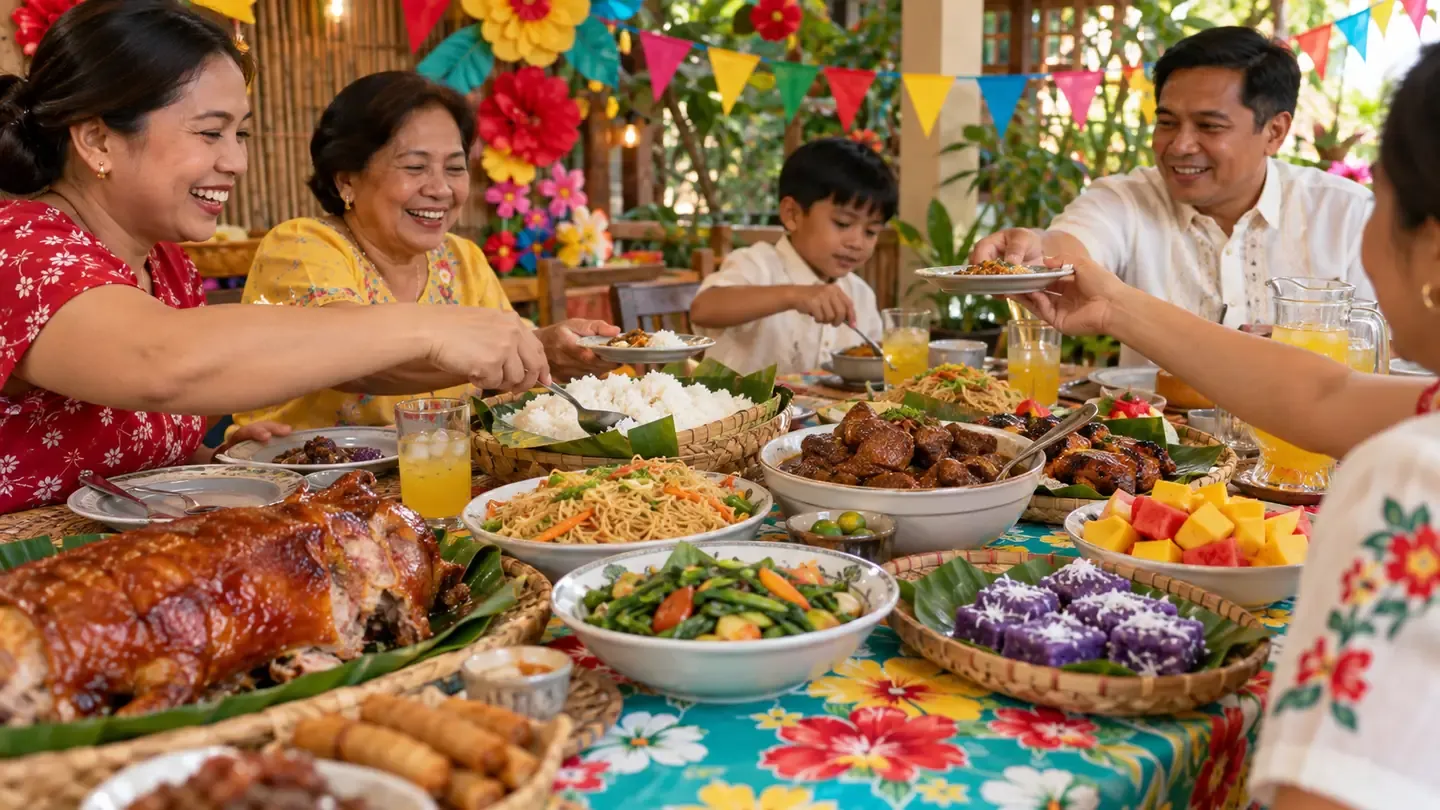
Depending on the family and occasion, the table might include examples such as:
- lechon or another festive pork dish;
- pancit;
- lumpia;
- adobo;
- barbecue;
- rice dishes;
- kakanin or other desserts.
The family may also have dishes that matter because they are part of its own yearly tradition.
When choosing the dishes, it helps to check:
- What does the family enjoy?
- Which dishes work together?
- What can be served comfortably in this venue?
- Which foods can hold well for the expected meal schedule?
- How much serving and replenishment work can the host manage?
A practical fiesta menu feels generous because the whole table works, not because it contains the longest possible list of dishes.
When the Table Feels Too Similar
When every dish is fried, very rich, very sweet or very saucy, guests may have fewer comfortable choices than the number of trays suggests.
Look for contrast.

You might combine:
- a richer main with a lighter supporting dish;
- meat with fish or chicken;
- noodles with rice rather than several similar starches;
- a savoury main with a vegetable dish;
- a rich dessert with fruit or another simpler option.
The menu does not have to be complicated.
A smaller number of complementary dishes is often easier to serve and enjoy than a crowded table with too much overlap.
How the Food Will Be Served
The menu is only one part of the handaan.

Decide where the buffet will go
The main food line works better away from a narrow passage or the entrance.
Guests should be able to queue, serve themselves and return to their seats without blocking people entering the venue.
Give drinks and dessert their own space when possible
Moving drinks away from the main buffet can reduce one common bottleneck.
The same applies to cake or dessert when many guests will approach it at the same time.
Prepare enough serving utensils
Every shared dish should have the utensil it needs.
Do not assume one spoon or tong can move between several trays comfortably.
Plan replenishment before the party
If food will be served in batches, decide:
- who watches the buffet;
- where backup food waits;
- how hot or chilled items will be handled;
- who replaces empty trays or containers.
Protect food outdoors
For outdoor or semi-outdoor gatherings, keep food protected from direct sun, rain, dust and unstable surfaces.
Also prepare a covered fallback area before bad weather becomes an emergency.
When Guests Arrive in Waves
Some family and community celebrations do not have one exact meal-service moment.
Relatives may arrive after a parish activity. Visitors may come at different times. People may stop by briefly and return to another part of the community programme.
If the arrival window is long:
- do not place every dish out too early;
- keep replenishment organised;
- make drinks easy to access;
- reserve enough seating for older relatives and guests who need it;
- decide how long the food area will stay active;
- keep clearing and waste management from interfering with incoming guests.
A long arrival window creates more work for the host even when the guest count is unchanged.
How Much Does the Family Want to Manage?
Fiesta hospitality is often associated with generosity, but the household still needs a scale it can realistically serve.
A larger spread also means more shopping, storage, cooking, receiving, serving, replenishment and cleanup. The household does not have to match the most elaborate handaan on the street. It is reasonable to simplify the food or order part of the meal when that makes the gathering easier to host.
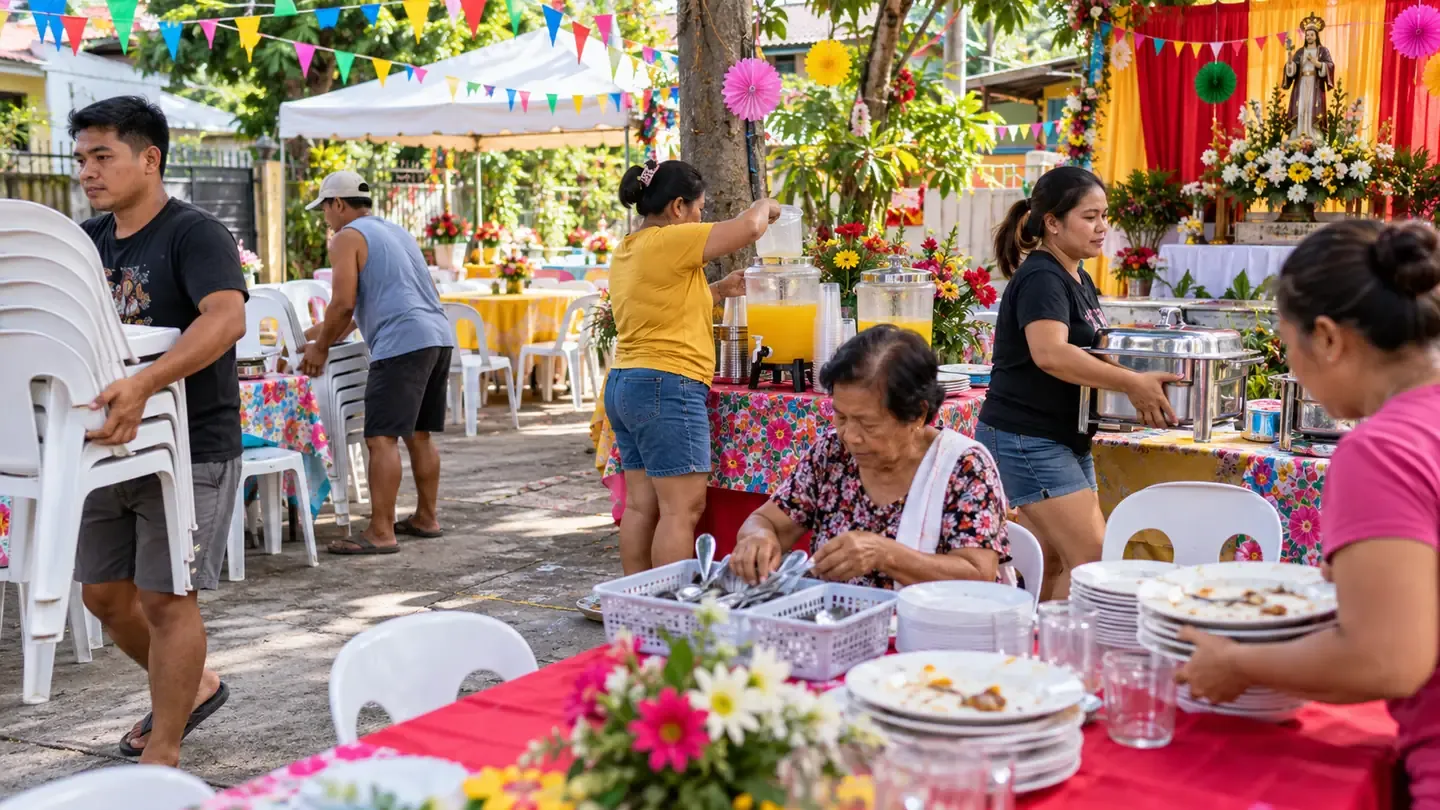
Cook most of the food at home
This gives the family the most control, especially when certain dishes are part of the household’s own tradition.
But it also means someone must manage shopping, cooking, storage, serving and cleanup.
Be realistic about whether the same people preparing the food are also expected to receive and spend time with guests.
Order Party Trays and manage the setup yourselves
Party Trays can work when the family wants prepared food but can handle:
- receiving;
- arranging the dishes;
- plates and utensils;
- serving;
- drinks;
- replenishment;
- clearing and cleanup.
The food is prepared for you, while your family handles the setup, serving and cleanup.
Use full-service catering
If the event needs coordinated food service, buffet setup, staffing or a more formal event arrangement, Jojie's Catering Services may be more suitable.
Final menu, service scope, equipment, staffing, schedule and charges should be confirmed in the written quotation.
Looking specifically for a Filipino Fiesta catering menu?
If you are ready to choose a catered Filipino menu, see the Pinoy Fiesta Catering Menu.
There you can review Jojie's current catered Fiesta menu and service options.
Before, During and After the Fiesta
A household handaan becomes easier when responsibilities are clear across the whole day, not only at mealtime.



Before guests arrive
Check:
- final food and delivery timing;
- where trays, hot food and chilled items will go;
- tables, chairs and serving utensils;
- drinking water and ice;
- who will receive deliveries or late food contributions;
- parking, gate or building access;
- weather protection if part of the setup is outdoors.
If the community has a procession, Mass, programme or road activity that affects access, account for it before setting the food schedule. For a large public celebration, check the current LGU, parish or official-organiser advisory rather than relying on last year’s route or timetable; road closures, crowd-control arrangements and programme times can change.
While the celebration is active
Someone should know who is watching:
- the buffet;
- drinks;
- replenishment;
- clearing and waste;
- older guests or anyone who needs a more comfortable seat;
- late arrivals.
The host does not have to do all of these jobs personally.
After the main meal
Plan what happens to:
- leftovers;
- reusable containers;
- borrowed tables or serving pieces;
- waste and clearing;
- food that still needs refrigeration.
A little organisation at the end prevents the host from finishing a long Fiesta day with another hour of avoidable sorting.
For a wider event checklist beyond the food, use the Party Planning Checklist.

Traditions, Homecoming and Community Connection
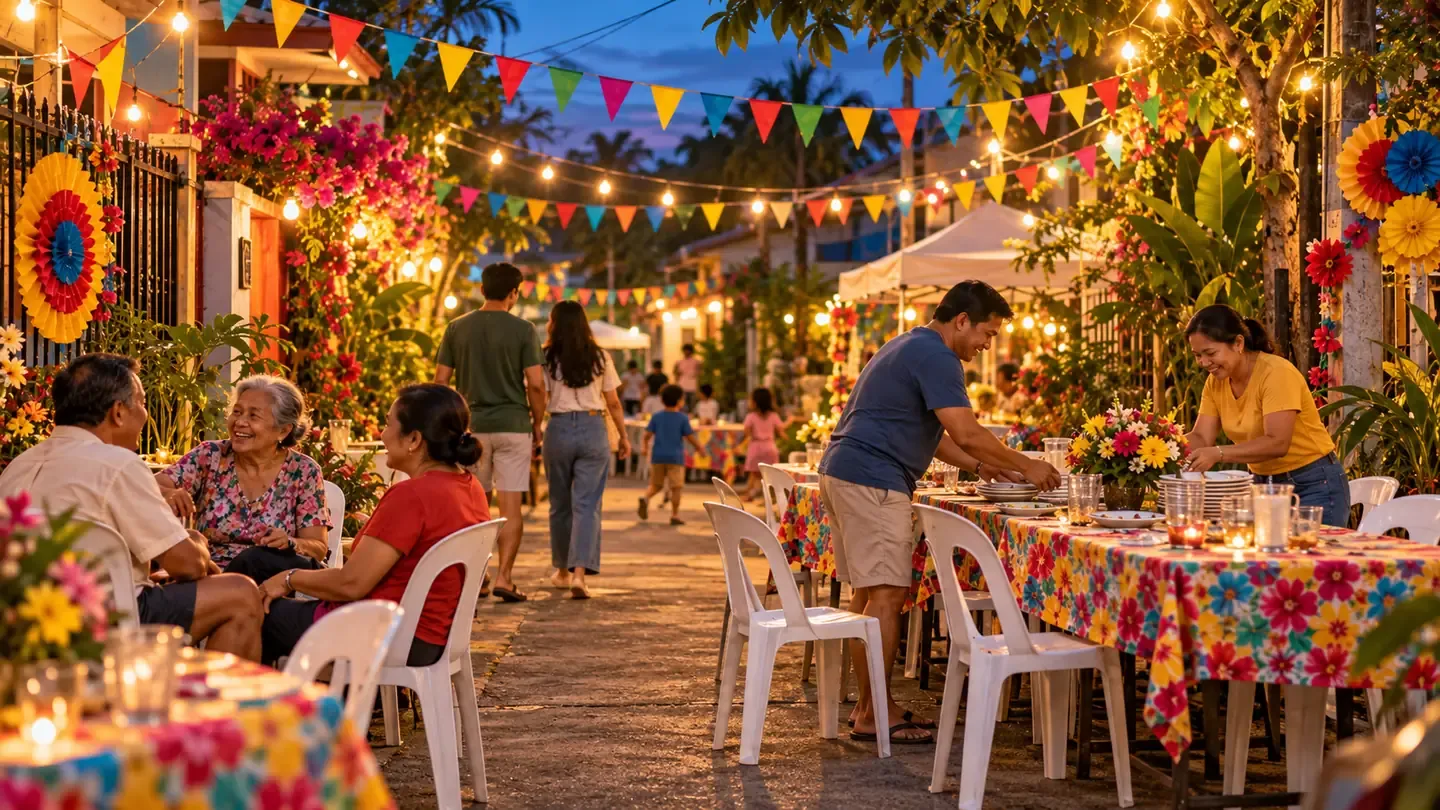
For some communities, the annual Fiesta is also a reason to return.
Relatives who now live elsewhere may come home. Former neighbours may visit. Families may repeat dishes, routines or small customs that have become associated with the same time each year.
That sense of return can be as important as the public programme.
It can also affect practical planning. The headcount may be less predictable than a formal event with one RSVP list, and the host may be receiving people across a longer period.
Not every family experiences Fiesta this way, and not every household keeps the same traditions from one generation to the next.
Keep the customs that genuinely belong to the people gathering rather than copying a generic list of things a Filipino Fiesta is “supposed” to have.
How Fiesta Practice Changes Across Places and Generations
Fiesta traditions are not frozen in time.
Some celebrations remain strongly devotional. Some have grown into larger municipal or tourism festivals with competitions, performances and sponsorship. In many places, religious, civic and entertainment elements sit beside one another.
Household practice changes too.
A family that once cooked everything at home may now order part of the food. Relatives may live farther away. Urban homes may have less space for a large open gathering. An organisation may adapt Fiesta food and decoration for an office event without reproducing the full traditions of a hometown celebration.
These changes do not create one modern replacement for the “old” Fiesta. They show why local context matters.
When a tradition is important, ask the people who actually practise it. When the goal is mainly to host a shared meal well, keep the plan practical and manageable.
A Simple Fiesta Food-Planning Flow
For a household handaan, these are the main things to settle:
- The celebration setting. Home, community space, parish, office or another venue.
- A working guest estimate. Use a range if the count is still uncertain.
- How guests will eat. Seated meal, buffet, a longer visiting window or shorter office meal.
- A balanced mix of dishes. Rice or noodles, mains, supporting dishes, dessert and drinks.
- What will be cooked at home and what will be ordered.
- Receiving, serving and replenishment. Decide who will handle each one.
- Seating, walkways, weather and cleanup.
- Written confirmation from a caterer or supplier. Confirm the final order, service scope, schedule and charges.
For a broader start-to-finish event checklist, use the Party Planning Checklist.
Frequently Asked Questions
What is a Filipino fiesta?
A Filipino fiesta is a recurring local or community celebration whose meaning varies by place. Many familiar town fiestas are connected to Catholic patronal traditions, while other local celebrations may emphasise harvest, civic identity, culture or a mixture of religious and secular activity. Household food and hospitality are often part of the occasion but are not identical everywhere.
Is a fiesta the same as a festival?
Not always. In Philippine usage the terms can overlap, especially when an older religious or community fiesta develops a larger civic, cultural or tourism programme. Some events are described mainly as festivals, while others remain strongly identified as fiestas. The local history and current programme usually explain the event better than forcing every celebration into one definition.
Are all Filipino fiestas religious?
No. Patronal and religious fiestas are important parts of Philippine tradition, but local celebrations also include civic, harvest, cultural and other community occasions. Some events combine several of these elements.
Do I need an invitation to visit someone’s home during a Fiesta?
It depends on the family and local custom. Some communities have a more open visiting tradition during Fiesta, while other households prepare only for invited relatives and friends. Do not assume that every home is open to anyone. If you are unsure, ask the host or the person who invited you.
Which Fiesta date should I follow — the feast day or the festival programme?
They can be different. A patronal feast may have a fixed religious date while the civic festival, parade, competition or public programme runs for several days or is scheduled on a different weekend. For a current visit or event plan, use the latest official programme from the LGU, parish or organiser.
What is the difference between a Fiesta and a handaan?
The Fiesta is the wider celebration or occasion. A handaan is more specifically the prepared meal or gathering for guests. A family can therefore have its own handaan as one part of a much larger town, parish or community Fiesta.
What food is usually served at a Filipino fiesta?
There is no single required Filipino fiesta menu. Familiar examples may include lechon, pancit, lumpia, barbecue, adobo, rice dishes, kakanin and other family or local favourites. The better menu is one that fits the people, venue, meal schedule and serving setup.
Does a Filipino fiesta need lechon?
No. Lechon is associated with many celebrations, but it is not required for every Fiesta. The menu should reflect the family, budget, guest count, venue and the kind of gathering being planned.
Should a guest bring food or a gift to a Fiesta?
There is no national rule. Expectations vary by family and community. If you have been invited and are unsure, ask the host rather than assuming that food, a gift or a contribution is expected.
How do I plan food for a Fiesta at home?
Use the guest estimate and available serving space to set the scale. A manageable number of complementary dishes is easier to handle when someone is already assigned to receiving, serving, replenishment and leftover storage, with plates, utensils and drinks ready as well.
Are Party Trays suitable for a Fiesta?
They can be when the family wants prepared food and can manage the rest of the setup. Someone still needs to receive the order, arrange the food, provide dining and serving items, replenish dishes and handle cleanup.
When is full catering more practical?
Full catering may be more suitable when the event needs coordinated service, buffet setup, staff, equipment or a more formal guest experience. The exact scope should be confirmed through the written quotation.
How can I keep a Fiesta buffet from getting crowded?
A less crowded buffet usually sits away from narrow entrances, with drinks or dessert separated where practical and enough space around the serving line for chairs and support tables to stay out of the queue path.
What should I prepare besides food?
The gathering still needs seating, drinking water, plates, serving utensils, waste and clearing, parking or building access, weather protection where relevant, and people responsible for receiving, replenishing and cleaning up.

A Fiesta That Works for the People You Are Hosting
A Filipino Fiesta can carry faith, local history, family memory, food and community life at the same time.
The household does not need to reproduce every familiar tradition to make the celebration meaningful.
Keep the customs that belong to your family or community. Serve food that works together. Give guests room to eat and move comfortably. Decide how much work the household can realistically carry.
For wider event planning, use the Party Planning Checklist.
If you want prepared food while managing the setup yourselves, Party Trays can cover the food portion of the celebration. If you want a catered Filipino menu with a more structured service arrangement, see Jojie's current Pinoy Fiesta Catering Menu.