
Event Rental Planning Guide
How Many Tables and Chairs Do I Need for an Event?
Estimate the dining tables, chairs, support tables, and venue space needed for events with 20 to 200 seated guests. Use the chart and planning steps below as a practical starting point before requesting a rental quotation.
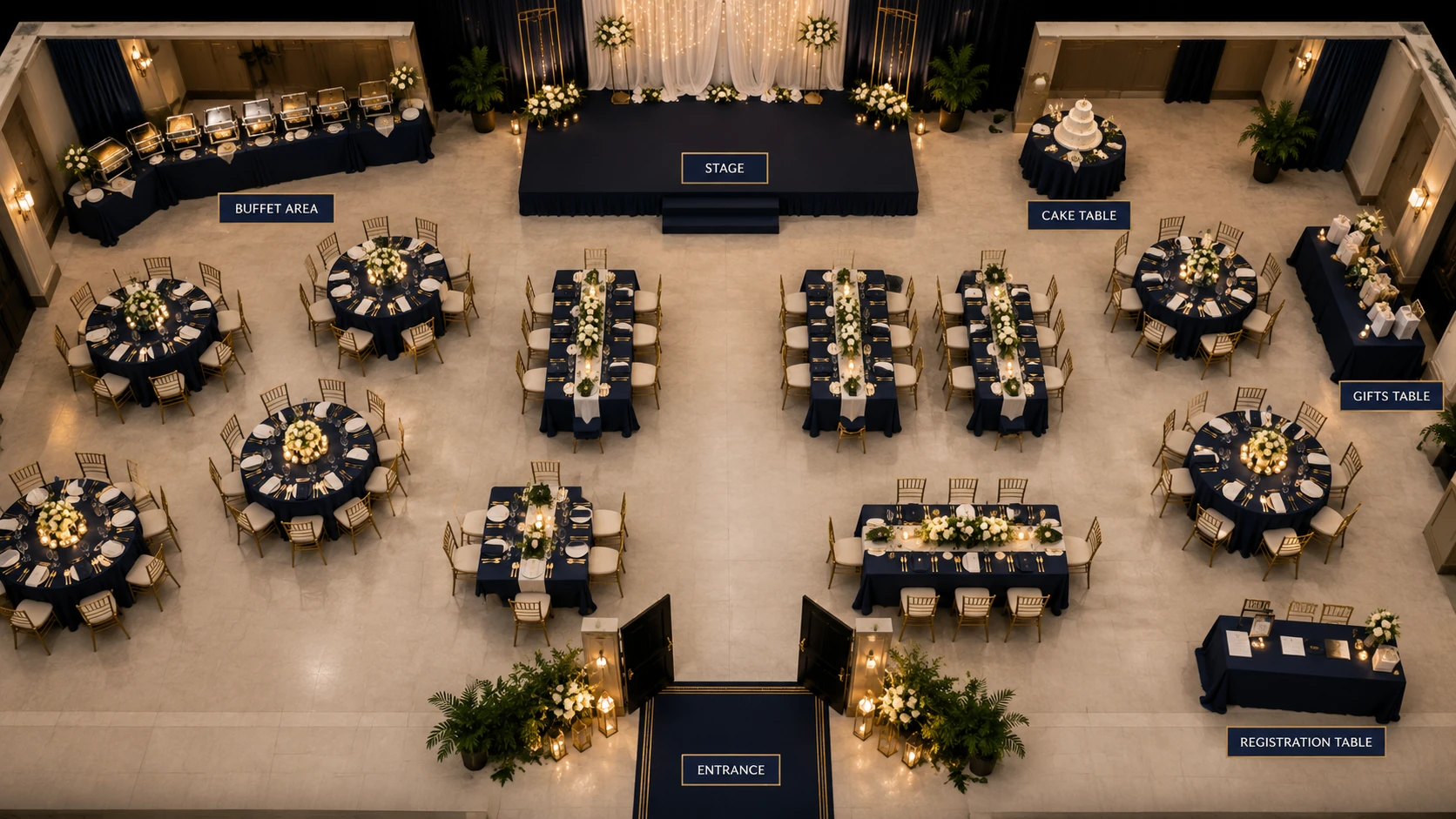
Quick answer: start with one chair for every seated guest
Then divide the seated guest count by your chosen table capacity and round up. Add buffet, registration, cake, gifts, drinks, equipment, supplier, and activity tables separately. The final setup must still fit the usable venue space.
The Basic Calculation
Start With These Four Numbers
Your exact setup may change, but these four checks give you a reliable first estimate.
One Chair Per Seated Guest
Begin with one chair for every person seated during the meal, ceremony, seminar, or programme.
Add a 5% to 10% Allowance
A small allowance can cover attendance changes, coordinators, suppliers, speakers, or performers.
Divide Guests by Table Capacity
Divide seated guests by the number assigned to each dining table, then round the result up.
Add Support Tables Separately
Buffet, registration, cake, gifts, drinks, equipment, suppliers, and activities need separate counts.
Quick Table and Chair Calculator
Estimated Quantities for 20 to 200 Guests
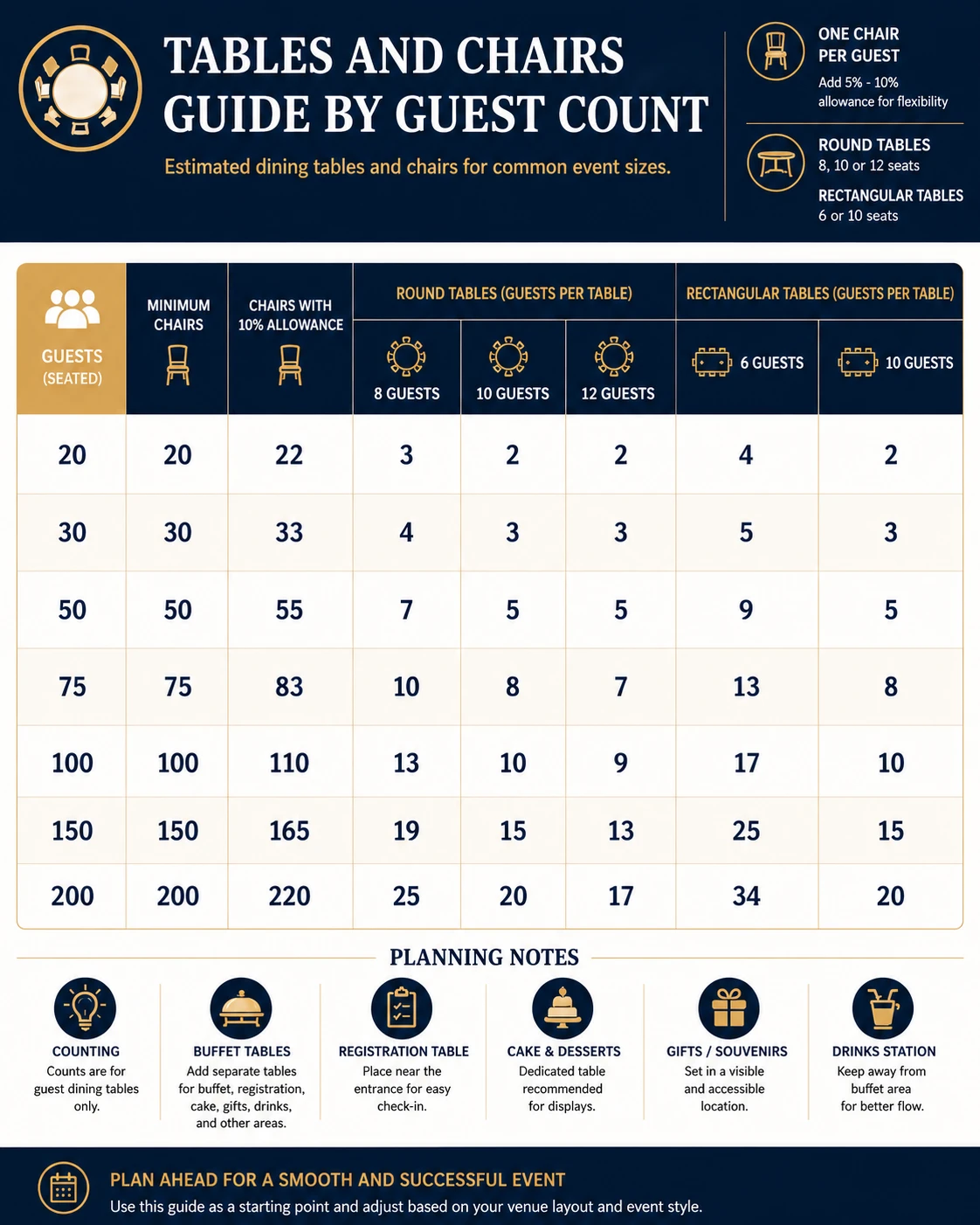
This chart compares round tables seating 8, 10, or 12 guests with rectangular tables seating 6 or 10. These are starting estimates for fully seated events.
| Guests | Minimum Chairs | Chairs With 10% Allowance | Round Tables for 8 | Round Tables for 10 | Round Tables for 12 | Rectangular Tables for 6 | Rectangular Tables for 10 |
|---|---|---|---|---|---|---|---|
| 20 | 20 | 22 | 3 | 2 | 2 | 4 | 2 |
| 30 | 30 | 33 | 4 | 3 | 3 | 5 | 3 |
| 50 | 50 | 55 | 7 | 5 | 5 | 9 | 5 |
| 75 | 75 | 83 | 10 | 8 | 7 | 13 | 8 |
| 100 | 100 | 110 | 13 | 10 | 9 | 17 | 10 |
| 150 | 150 | 165 | 19 | 15 | 13 | 25 | 15 |
| 200 | 200 | 220 | 25 | 20 | 17 | 34 | 20 |
Step-by-Step Planning
How to Calculate Your Tables and Chairs
Work through the event format, table capacity, support areas, and venue restrictions before finalising the rental order.
Confirm How Many Guests Will Be Seated
Use expected attendance rather than the total number of invitations. Consider coordinators, speakers, performers, photographers, drivers, suppliers, accompanying parents, and reserved or accessibility seating.
Decide Whether Everyone Needs a Dining Seat
Weddings, birthdays, baptisms, anniversaries, and formal dinners usually seat everyone. Seminars may use theatre or classroom layouts, while cocktail events may combine standing guests with limited seating.
Choose the Number of Guests Per Table
Lower table capacity gives guests more room but requires more tables and floor space. For example, 75 guests divided by 10 equals 7.5, so prepare 8 tables.
Add Non-Dining Tables Separately
Do not include support tables in the guest-dining calculation. Count each one according to the programme, food service, suppliers, and activity areas.
Practical Examples
Sample Setups for 50, 100, and 200 Guests
These starting examples assume a fully seated event using round tables for 10. Support-table quantities still depend on the menu, programme, and venue.
Birthday, Baptism, or Family Gathering
- 5 round dining tables for 10
- 50 chairs, or up to 55 with allowance
- Separate buffet setup
- 1 cake or dessert table
- 1 gift table when needed
- 1 drinks table when served separately
Reception or Company Function
- 10 round dining tables for 10
- 100 to 110 chairs
- Buffet or food-service tables
- Cake or dessert table
- Gift or souvenir table
- Drinks station and registration when needed
Wedding or Community Programme
- 20 round dining tables for 10
- 200 to 220 chairs
- Multiple buffet points when needed
- Registration and welcome area
- Separate dessert and drinks stations
- Supplier, equipment, or VIP tables as required
Space Matters as Much as Quantity
Check the Venue Before Finalising the Table Count
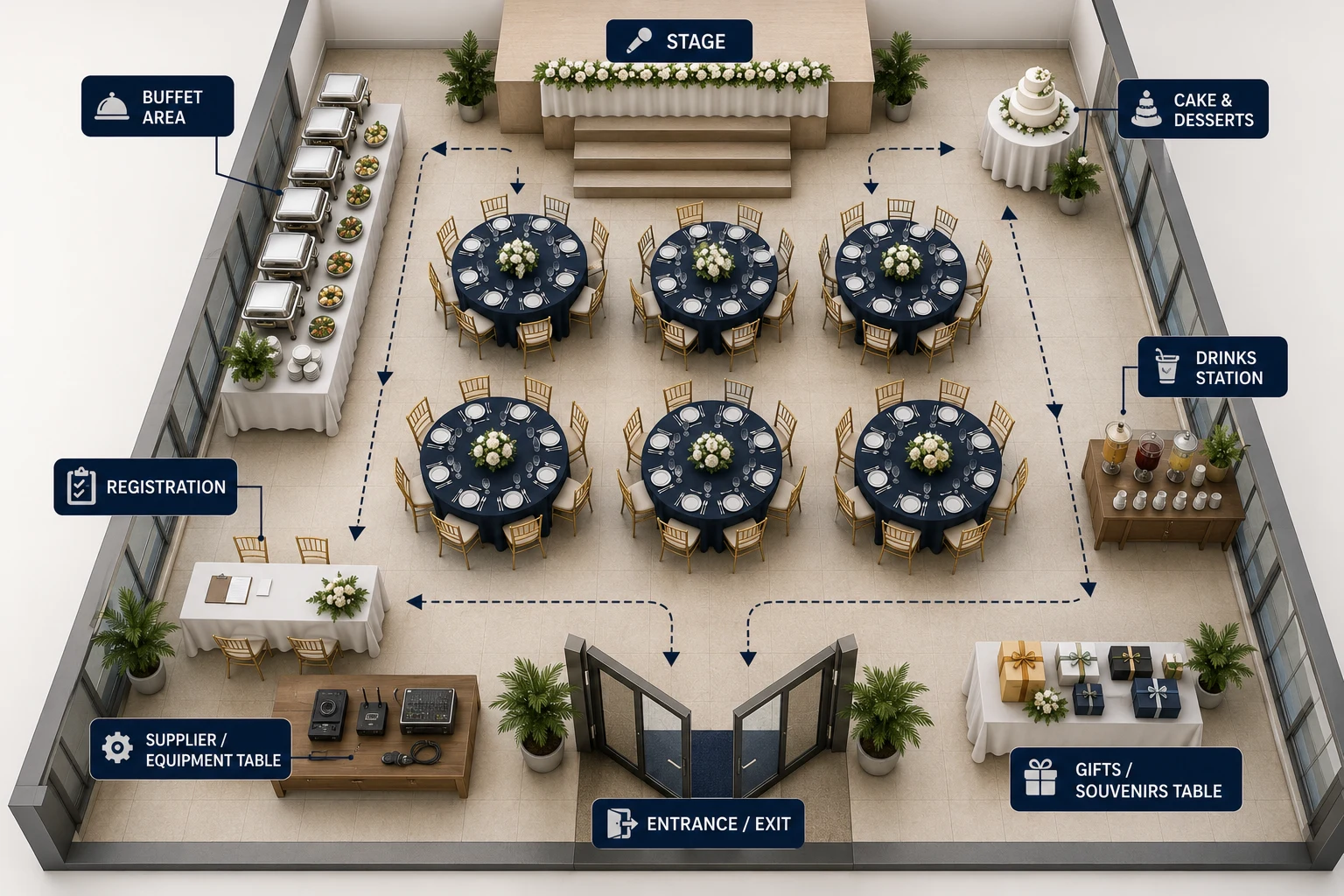
A mathematical table count does not guarantee that the arrangement will fit. The room still needs safe, comfortable space for guests, staff, suppliers, food service, and the programme.
- Entrances and emergency exits: Keep all access and evacuation routes open.
- Stage and programme areas: Protect sightlines and space for speakers or performers.
- Buffet queues and service routes: Allow guests and catering staff to move without conflict.
- Registration and waiting areas: Avoid congestion near the main entrance.
- Pillars and fixed structures: Measure usable space rather than relying only on advertised capacity.
- Dance floors and activities: Reserve space before filling the room with dining tables.
- Supplier and equipment areas: Include photography, video, audio, and coordinator workspaces.
- Delivery restrictions: Confirm loading, parking, elevators, gate passes, and collection deadlines.
Choose Seating That Fits the Occasion
Monobloc Chairs or Gold Tiffany Chairs?
The quantity calculation is similar, but the event style, presentation, venue, and budget may affect which chair is more suitable.
Monobloc Chairs
A practical option for birthdays, school functions, church gatherings, seminars, barangay events, community programmes, and casual family occasions.
- Flexible for many event formats
- Useful for larger seating requirements
- Available without covers, with white covers, or with covers and ribbons
- Good when practicality and value are priorities
Gold Tiffany Chairs
Commonly selected for weddings, debuts, anniversaries, formal dinners, corporate galas, and styled celebrations.
- Elegant appearance for formal occasions
- Works well with styled table settings
- Photographs well in reception layouts
- Good when presentation is a major priority
Avoid Last-Minute Changes
Common Quantity and Layout Mistakes
Most problems come from incomplete attendance estimates, missing support tables, or planning a layout before checking the usable venue space.
Prepare Your Inquiry
Details to Send for a Rental Recommendation
Complete event information makes it easier to suggest a practical quantity, layout, delivery plan, and quotation.
- Event date and event type
- Complete venue name and address
- Working seated guest count
- Fully seated, theatre, classroom, or cocktail format
- Preferred table and chair types
- Meal service and programme format
- Setup and programme schedule
- Loading, elevator, stair, parking, or gate-pass instructions
- Collection or pull-out schedule
- Outdoor rain plan when applicable
Continue Planning
Related Table and Chair Rental Guides
Use these guides to choose table types, compare chairs, and review the available rental options before requesting a quotation.
Table and Chair Planning FAQ
Frequently Asked Questions
These estimates are practical starting points. The final quantity should be checked against the venue, programme, table configuration, and supplier requirements.
How many chairs do I need for 100 guests?
Prepare at least 100 chairs for a fully seated event. Consider 105 to 110 chairs when attendance may change or when coordinators, performers, suppliers, speakers, or unexpected guests also require seating.
How many round tables do I need for 100 guests?
You would need approximately 13 round tables seating 8, 10 round tables seating 10, or 9 round tables seating 12. Always round fractions up to the next whole table.
How many rectangular tables do I need for 100 guests?
You would need approximately 17 rectangular tables seating 6 or 10 rectangular tables seating 10. The final arrangement depends on table dimensions, seating positions, and available venue space.
Do buffet tables count as guest dining tables?
No. Calculate buffet and food-service tables separately. The required number depends on the menu, serving equipment, venue space, and expected guest flow.
Do children need separate tables and chairs?
Children may use standard dining tables or kiddie tables and chairs depending on age, programme, and available space. Include children in the guest count unless they will use a separate seating area.
Should I include chairs for catering staff and suppliers?
Service staff normally work during the event, but coordinators, drivers, photographers, performers, speakers, and suppliers may need a separate rest or meal area. Confirm the requirement with the event team.
Can I combine round and rectangular tables?
Yes. Many events use round tables for guest dining and rectangular tables for buffets, registration, cake, gifts, drinks, suppliers, or selected dining rows.
Can Jojie’s help calculate the quantity?
Yes. Send the event date, venue, working guest count, seating format, preferred table and chair styles, setup schedule, programme details, and venue-access information for a practical starting recommendation.
Ready to Check Availability?
Plan Your Tables and Chairs With Jojie’s
Use this guide as an initial estimate. Once you know the event date, venue, working guest count, seating format, and preferred rental items, send the details for a customised quotation.